Advertisements
Advertisements
प्रश्न
Write scientific reason.
Coins are made from metals and alloys.
Advertisements
उत्तर
- Coins are made from metals and alloys because metals and their alloys possess the property of malleability. So, they can be hammered into flat shape without breaking.
- Metals and alloys used for making coins should be corrosion resistance and bright in colour. They should also be hard and wear resistance.
APPEARS IN
संबंधित प्रश्न
Tinning : Tin : : Galvanizing : _________
Which of the following methods is suitable for preventing an iron frying pan from rusting?
Two methods by which rusting of iron can be prevented are ______ and ______.
Explain how painting of an iron gate prevents it from rusting.
Explain why Iron sheets are coated with zinc during galvanization.
Name any three objects (or structures) which are gradually damaged by the corrosion of iron and steel.
The chemical reaction involved in the corrosion of iron metal is that of ______.
What is meant by galvanisation? Why is it done?
Explain why, iron sheets are coated with zinc.
______ and ______ are necessary for the rusting of iron.
Why is an iron grill painted frequently?
Name any two metals which do not corrode easily.
Brass is an alloy of ______.
Four metals P, Q, R and S are all obtained by the reduction of their oxides with carbon. Metal P is used to form a thin layer over the sheets of metal S to prevent its corrosion. Metal Q is used for electroplating tiffin boxes made of metal S whereas metal R is used in making car batteries. Metals Q and R form an alloy called solder. What are metals P, Q, R and S? How have you arrived at this conclusion?
Explain how the activity series accounts for each of the following:
tendency to corrosion
No chemical reaction takes place when granules of a solid, A, are mixed with the powder of another solid, B. However when the mixture is heated, a reaction takes place between its components. One of the products, C, is a metal and settles down in the molten state while the other product, D, floats over it. It was observed that the reaction is highly exothermic.
(i) Based on the given information make an assumption about A and B and write a chemical equation for the chemical reaction indicating the conditions of reaction, physical state of reactants and products and thermal status of reaction.
(ii) Mention any two types of reactions under which above chemical reaction can be classified.
Find the odd man out:
Give reason.
A wooden article should be polished.
Give a reason why rust turns moist red litmus blue.
State whether the statement given below is true or false. If false write the correct statement.
Graphite is a lustrous non-metal which conducts electricity.
_______ is an alloy made from iron, carbon and chromium.
Which of the following method is used to prevent the accumulation of greenish layer on brass due to corrosion?
Corrosion of silver causes a black layer of _______.
When one of the metals in an alloy is mercury the alloy is called _______.
Find the odd one out and give its explanation.
Write the name.
An alloy of copper and tin-
Draw a neat labelled diagram.
Electrolysis
What is rust?
Observe the following figure and write the answer of the question.
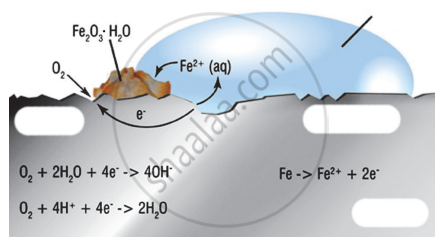
- Which process is shown in the figure?
- Explain the chemical reaction shown in the figure.
- Write the reactions on anode and cathode.
Generally, when metals are treated with mineral acids, hydrogen gas is liberated but when metals (except Mn and Mg), treated with HNO3, hydrogen is not liberated, why?
Galvanisation is a process used to prevent the rusting of which of the following?
Explain the following:
Lime water turns milky on passing carbon dioxide gas into it.
Explain the following:
Bubbles are produced when acetic acid is added to a solution of sodium hydrogencarbonate.
Gold plated ornaments is the example of ______.
Give scientific reasons.
Silver amalgam is used for filling dental cavities.
Explain the chemical reactions in rusting of iron.
