Advertisements
Advertisements
Question
Write scientific reason.
Coins are made from metals and alloys.
Advertisements
Solution
- Coins are made from metals and alloys because metals and their alloys possess the property of malleability. So, they can be hammered into flat shape without breaking.
- Metals and alloys used for making coins should be corrosion resistance and bright in colour. They should also be hard and wear resistance.
APPEARS IN
RELATED QUESTIONS
Explain how painting of an iron gate prevents it from rusting.
What is anodising? Give its applications.
Name any three objects (or structures) which are gradually damaged by the corrosion of iron and steel.
What is meant by galvanisation? Why is it done?
Explain why, iron sheets are coated with zinc.
State two conditions for the rusting of iron.
______ and ______ are necessary for the rusting of iron.
Explain why, though aluminium is more reactive than iron, yet there is less corrosion of aluminium when both are exposed to air.
Name any two metals which do not corrode easily.
Give the constituents of brass.
What are the constituents of stainless steel?
What are the special properties of stainless steel?
If copper is kept exposed to damp air for a considerable time, it gets a green coating on its surface. This is due to the formation of ______.
A metal X which is resistant to corrosion is produced by the electrolysis of its molten oxide whereas another metal Y which is also resistant to corrosion is produced by the reduction of its oxide with carbon. Metal X can be used in powder form in thermite welding whereas metal Y is used in making cathodes of ordinary dry cells.
- Name the metals X and Y.
- Which of the two metals is more reactive: X or Y?
- Name one ore or metal X. Also write its chemical formula.
- Name one ore of metal Y. Also write its chemical formula.
- Name one alloy of metal X and one alloy of metal Y.
Four metals P, Q, R and S are all obtained by the reduction of their oxides with carbon. Metal P is used to form a thin layer over the sheets of metal S to prevent its corrosion. Metal Q is used for electroplating tiffin boxes made of metal S whereas metal R is used in making car batteries. Metals Q and R form an alloy called solder. What are metals P, Q, R and S? How have you arrived at this conclusion?
Mention two uses of the following metals and non-metals
Iron
Bronze is an alloy of ______.
Name the metal which is a constituent of blood pigment?
Explain how the activity series accounts for each of the following:
tendency to corrosion
Explain with reason:
Roasting is carried out on sulphide ores and not on carbonate ores.
Observe the following picture a write down the chemical reaction with the explanation.
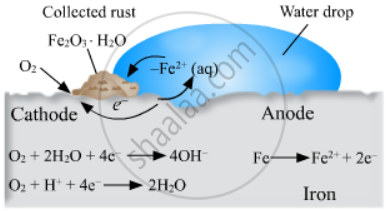
Complete the process of iron rusting by filling the blanks. Suggest a way to prohibit the process.
The iron rust is formed due to........................... reaction. Different
regions on iron surface become anode and cathode.
Reaction on anode region :
`F_e(s) → Fe^(2+) (aq) +2e^-`
Reaction on anode region :
`O_2(g) + 4H^+(aq) +............................ → 2H_2 O (l) `
When Fe2+ ions migrate from anode region they react with ................... to form Fe3+ ions.
A reddish coloured hydrated oxide is formed from ............... ions. It is called rust.
`2Fe_(3+) (aq) + 4H_2O(l) → ................. + 6H_+(aq) `
A way to prevent rusting ..................................................................
Identify the process shown in the diagram and explain it in short

Answer the following question:
What is corrosion? Do gold ornaments corrode? Justify.
Answer the following question.
List two properties of alloys.
Give reason.
An iron article should be given a coat of paint
Give reason.
Copper and brass utensils should be tinned.
State whether the statement given below is true or false. If false write the correct statement.
Either oxygen or moisture is essential for rusting.
Write a short note on Alloying.
Pressure cooker : Anodizing : : Silver plated spoons : _______
Find the correlation:
Bronze : ______ :: Tin : Cu+Zn.
Write scientific reason.
On exposure to air, silver articles turn blackish after some time.
Observe the following diagram and give answers.
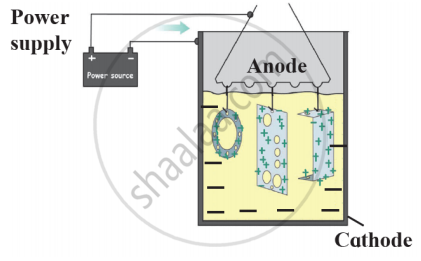
- Name this method of prevention of corrosion.
- For prevention of which metal this method is used?
- What is used as anode in this method?
Observe the following diagram and write answers.
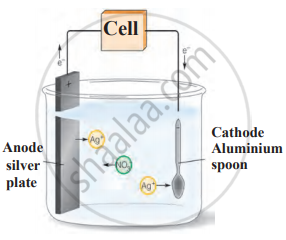
- Name the method.
- Explain the method.
- Give two examples of this method.
Observe the following figure and write the answer of the question.
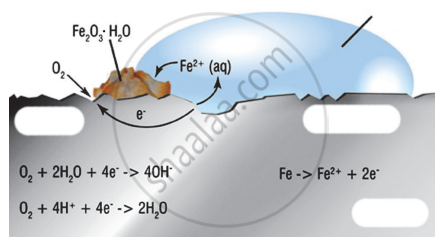
- Which process is shown in the figure?
- Explain the chemical reaction shown in the figure.
- Write the reactions on anode and cathode.
Which among the following alloys contain mercury as one of its constituents?
State whether the following statement is true or false:
Ships suffer a lot of damage though they are painted.
Explain the following:
Bubbles are produced when acetic acid is added to a solution of sodium hydrogencarbonate.
Give an example of a chemical reaction for the following situation:
Sound is produced
