Advertisements
Advertisements
Question
Gold plated ornaments is the example of ______.
Options
Electroplating
Alloying
Anodizing
Galvanizing
Advertisements
Solution
Gold plated ornaments is the example of Electroplating.
APPEARS IN
RELATED QUESTIONS
What is an alloy?
Give two examples of alloys with their chemical composition.
What are alloys?
Which of the following methods is suitable for preventing an iron frying pan from rusting?
Explain why Iron sheets are coated with zinc during galvanization.
Choose the correct answer from the options given below:
Heating an ore in a limited supply of air or in the absence of air at a temperature just below its melting point is known as
A. Smelting
B. Ore-dressing
C. Calcination
D. Bessemerisation
The chemical reaction involved in the corrosion of iron metal is that of ______.
In one method of rust prevention, the iron is not coated with anything. Which is this method?
The process of depositing a thin layer of zinc on iron articles is called ______.
Tiffin boxes are electroplated with ______ but car bumpers are electroplated with ______ to protect them from rusting.
Explain why, though aluminium is more reactive than iron, yet there is less corrosion of aluminium when both are exposed to air.
What is corrosion?
With the help of labelled diagrams, describe an activity to find out the conditions under which iron rusts.
Explain why, the galvanised iron article is protected against rusting even if the zinc layer is broken.
Four metals P, Q, R and S are all obtained by the reduction of their oxides with carbon. Metal P is used to form a thin layer over the sheets of metal S to prevent its corrosion. Metal Q is used for electroplating tiffin boxes made of metal S whereas metal R is used in making car batteries. Metals Q and R form an alloy called solder. What are metals P, Q, R and S? How have you arrived at this conclusion?
Name the metal which is a constituent of plant pigment?
State under what conditions corrosion is faster ?
No chemical reaction takes place when granules of a solid, A, are mixed with the powder of another solid, B. However when the mixture is heated, a reaction takes place between its components. One of the products, C, is a metal and settles down in the molten state while the other product, D, floats over it. It was observed that the reaction is highly exothermic.
(i) Based on the given information make an assumption about A and B and write a chemical equation for the chemical reaction indicating the conditions of reaction, physical state of reactants and products and thermal status of reaction.
(ii) Mention any two types of reactions under which above chemical reaction can be classified.
Write scientific reasons.
Lemon or tamarind is used for cleaning copper vessels turned greenish.
Complete the process of iron rusting by filling the blanks. Suggest a way to prohibit the process.
The iron rust is formed due to........................... reaction. Different
regions on iron surface become anode and cathode.
Reaction on anode region :
`F_e(s) → Fe^(2+) (aq) +2e^-`
Reaction on anode region :
`O_2(g) + 4H^+(aq) +............................ → 2H_2 O (l) `
When Fe2+ ions migrate from anode region they react with ................... to form Fe3+ ions.
A reddish coloured hydrated oxide is formed from ............... ions. It is called rust.
`2Fe_(3+) (aq) + 4H_2O(l) → ................. + 6H_+(aq) `
A way to prevent rusting ..................................................................
Identify the process shown in the diagram and explain it in short

Find the odd man out:
Give reason.
A wooden article should be polished.
State whether the statement given below is true or false. If false write the correct statement.
Either oxygen or moisture is essential for rusting.
State whether the statement given below is true or false. If false write the correct statement.
Graphite is a lustrous non-metal which conducts electricity.
Observe the following picture and answer the following questions:
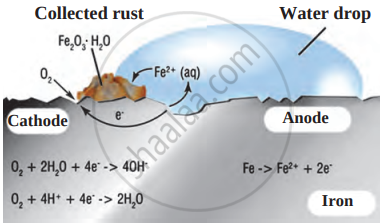
- What is rust?
- Write the chemical formula of rust.
- Write the reaction of oxidation of iron at the anode.
- Write the reaction of oxidation of iron at the cathode.
- What is corrosion?
_______ is an alloy made from iron, carbon and chromium.
Find the correlation:
Bronze : ______ :: Tin : Cu+Zn.
Find the odd one out and give its explanation.
Match the columns.
| Group A | Group B |
| 1) Electroplating | a) Pressure cooker |
| 2) Anodising | b) Silver plated spoons |
| c) Coating of tin on copper | |
| d) Coating of Zinc on iron |
Draw a neat labelled diagram.
Electrolysis
Observe the following diagram and give answers.
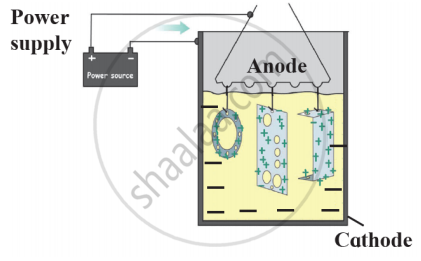
- Name this method of prevention of corrosion.
- For prevention of which metal this method is used?
- What is used as anode in this method?
Observe the following diagram and write answers.
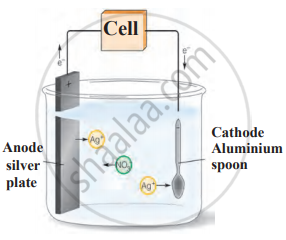
- Name the method.
- Explain the method.
- Give two examples of this method.
Observe the following figure and write the answer of the question.
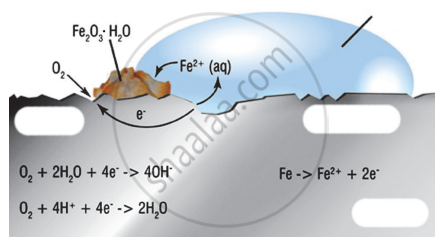
- Which process is shown in the figure?
- Explain the chemical reaction shown in the figure.
- Write the reactions on anode and cathode.
Give solutions by giving examples of corrosion?
Generally, when metals are treated with mineral acids, hydrogen gas is liberated but when metals (except Mn and Mg), treated with HNO3, hydrogen is not liberated, why?
Explain the following:
Lime water turns milky on passing carbon dioxide gas into it.
Give scientific reasons.
Silver amalgam is used for filling dental cavities.
