Advertisements
Advertisements
Question
Write a short note on Alloying.
Advertisements
Solution
- The homogenous mixture formed by mixing metal with other metals or nonmetals in a certain proportion is called an alloy.
- Majority of the metallic substances used presently are in the form of alloys. The main intention behind this is to decrease the intensity of corrosion of metals.
- For example, bronze is an alloy formed from 90% copper and 10% tin. Bronze statues do not get affected by the sun and rain. Stainless steel does not get stains with air or water and also does not rust. It is an alloy made from 74% iron, 18% chromium and 8% carbon.
- In recent times various types of alloys are used for minting coins.
APPEARS IN
RELATED QUESTIONS
Why do we apply paint on iron articles?
Give reasons:
Platinum, gold and silver are used to make jewellery.
Two methods by which rusting of iron can be prevented are ______ and ______.
Explain why rusting of iron objects is faster in coastal areas than in deserts.
Explain why Iron sheets are coated with zinc during galvanization.
What is anodising? Give its applications.
What special name is given to the corrosion of iron?
Name the metal which is used for galvanising iron.
The corrosion of copper produces a ______ coating of basic copper carbonate on its surface.
Name two metals which resist corrosion due to the formation of a thin, hard and impervious layer of oxide on their surface.
What are the special properties of stainless steel?
Brass is an alloy of ______.
Bronze is an alloy of ______.
Identify the process shown in the diagram and explain it in short

Choose the correct alternative and rewrite the following:
Iron is _____________________.
Give reason.
A wooden article should be polished.
Give reason.
Copper and brass utensils should be tinned.
Explain the term – rusting and give a word equation for the formation of rust. If polished iron nails are kept in three separate test tubes, state the contents in each test tube required, to prove the conditions for rusting.
State whether the statement given below is true or false. If false write the correct statement.
Graphite is a lustrous non-metal which conducts electricity.
Observe the following picture and answer the following questions:
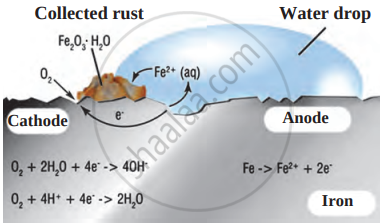
- What is rust?
- Write the chemical formula of rust.
- Write the reaction of oxidation of iron at the anode.
- Write the reaction of oxidation of iron at the cathode.
- What is corrosion?
Corrosion of silver causes a black layer of _______.
_______ forms a green colour in the water.
Find the odd one out and give its explanation.
Write scientific reason.
Coins are made from metals and alloys.
Observe the following diagram and give answers.
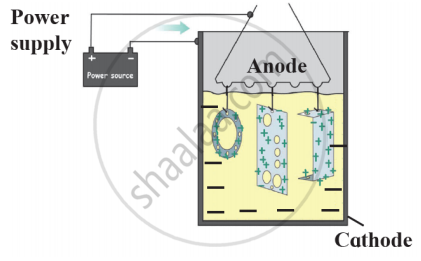
- Name this method of prevention of corrosion.
- For prevention of which metal this method is used?
- What is used as anode in this method?
Observe the following diagram and write answers.
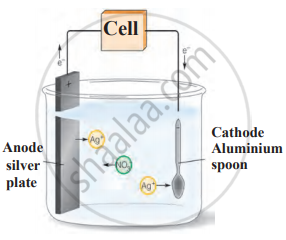
- Name the method.
- Explain the method.
- Give two examples of this method.
Give the equation for the formation of rust.
State two conditions necessary for rusting of iron.
Galvanisation is a method of protecting iron from rusting by coating it with a thin layer of ____________.
Copper objects lose their shine and form green coating of ____________.
The table shown below gives information about four substances: A, B, C and D.
| SUBSTANCE | MELTING POINT (K) | ELECTRICAL CONDUCTIVITY | |
| SOLID | LIQUID/ AQUEOUS | ||
| A | 295 | Good | Good |
| B | 1210 | Poor | Good |
| C | 1890 | Poor | Good |
| D | 1160 | Poor | Poor |
Identify Ionic compounds from the above given substances.
Marble’s popularity began in ancient Rome and Greece, where white and off-white marble were used to construct a variety of structures, from hand-held sculptures to massive pillars and buildings.

The substance not likely to contain CaCO3 is:
Identify the correct statement from the following:
Alloys are homogeneous mixtures of a metal with a metal or non-metal. Which among the following alloys contain non-metal as one of its constituents?
Explain the following:
Lime water turns milky on passing carbon dioxide gas into it.
In ______ process a layer of molten tin is deposited on metals.
Describe two changes that are harmful. Explain why you consider them harmful. How can you prevent them?
