Advertisements
Advertisements
Question
Draw a neat labelled diagram.
Electroplating
Advertisements
Solution
Electroplating-

APPEARS IN
RELATED QUESTIONS
Write two methods of preventing the rusting of iron.
Two methods by which rusting of iron can be prevented are ______ and ______.
What is anodising? Give its applications.
What type of chemical reaction is involved in the corrosion of iron?
In one method of rust prevention, the iron is not coated with anything. Which is this method?
The corrosion of copper produces a ______ coating of basic copper carbonate on its surface.
Name two metals which resist corrosion due to the formation of a thin, hard and impervious layer of oxide on their surface.
What are the special properties of stainless steel?
Name a common metal which is highly resistant to corrosion.
A common metal which is highly resistant to corrosion is ______.
Brass is an alloy of ______.
Bronze is an alloy of ______.
Name the metal which is a constituent of blood pigment?
Corrosion can be an advantage in some case.Explain ?
No chemical reaction takes place when granules of a solid, A, are mixed with the powder of another solid, B. However when the mixture is heated, a reaction takes place between its components. One of the products, C, is a metal and settles down in the molten state while the other product, D, floats over it. It was observed that the reaction is highly exothermic.
(i) Based on the given information make an assumption about A and B and write a chemical equation for the chemical reaction indicating the conditions of reaction, physical state of reactants and products and thermal status of reaction.
(ii) Mention any two types of reactions under which above chemical reaction can be classified.
Observe the following picture a write down the chemical reaction with the explanation.
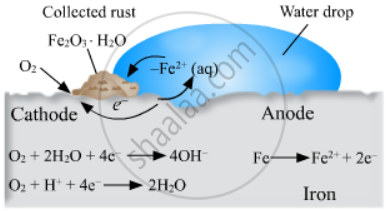
Write scientific reasons.
Lemon or tamarind is used for cleaning copper vessels turned greenish.
Answer the following question.
a) What is meant by corrosion?
b) Write names of any two methods of prevention of corrosion.
c) In which method, metal like copper, aluminium are coated with a thin layer of their oxides by means of electrolysis.
d) Explain this method with diagram.
Write three methods of preventing rusting of iron.
Give reason.
An iron article should be given a coat of paint
State whether the statement given below is true or false. If false write the correct statement.
Either oxygen or moisture is essential for rusting.
Write a short note on Alloying.
_______ forms a green colour in the water.
When one of the metals in an alloy is mercury the alloy is called _______.
Write scientific reason.
On exposure to air, silver articles turn blackish after some time.
Observe the following diagram and give answers.
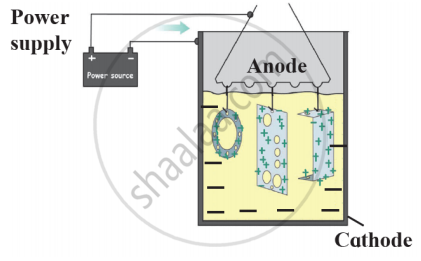
- Name this method of prevention of corrosion.
- For prevention of which metal this method is used?
- What is used as anode in this method?
Observe the following figure and write the answer of the question.
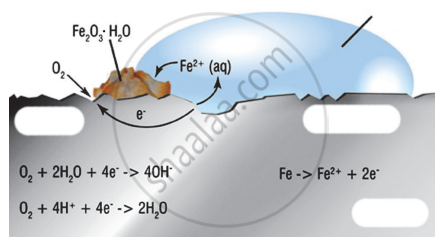
- Which process is shown in the figure?
- Explain the chemical reaction shown in the figure.
- Write the reactions on anode and cathode.
The process of coating the surface of the metal with a thin layer of zinc is called ______
What is rust?
Give the equation for the formation of rust.
Copper objects lose their shine and form green coating of ____________.
The diagram shows the reaction between metal and dil. acid.

What is the reason for different behaviour of Mg in test tube B?
The table shown below gives information about four substances: A, B, C and D.
| SUBSTANCE | MELTING POINT (K) | ELECTRICAL CONDUCTIVITY | |
| SOLID | LIQUID/ AQUEOUS | ||
| A | 295 | Good | Good |
| B | 1210 | Poor | Good |
| C | 1890 | Poor | Good |
| D | 1160 | Poor | Poor |
Identify Ionic compounds from the above given substances.
Identify the correct statement from the following:
Iron pillar near the Qutub Minar in Delhi is famous for the following facts. Which of these facts is responsible for its long stability?
Galvanisation is a process used to prevent the rusting of which of the following?
Describe two changes that are harmful. Explain why you consider them harmful. How can you prevent them?
