Advertisements
Advertisements
Question
Answer the following question:
What is corrosion? Do gold ornaments corrode? Justify.
Advertisements
Solution
- The slow process of decay or distinction ions of a metal due to the effect of air, moisture, acids, alkalies, or other chemicals on it is called corrosion.
- Ordinarily, gold ornaments do not get corroded.
- Gold is one of the least reactive metals. It does not react with air, moisture, sweat, or ordinary pollutants in air or water. Hence, it does not get corroded.
APPEARS IN
RELATED QUESTIONS
What is an alloy?
Write two methods of preventing the rusting of iron.
Explain the term corrosion.
What is anodising? Give its applications.
What special name is given to the corrosion of iron?
What type of chemical reaction is involved in the corrosion of iron?
What is meant by galvanisation? Why is it done?
State two conditions for the rusting of iron.
In one method of rust prevention, the iron is not coated with anything. Which is this method?
The corrosion of copper produces a ______ coating of basic copper carbonate on its surface.
______ and ______ are necessary for the rusting of iron.
Name the metal which is a constituent of plant pigment?
Explain how the activity series accounts for each of the following:
tendency to corrosion
Compare roasting and calcination.
Write scientific reasons.
Lemon or tamarind is used for cleaning copper vessels turned greenish.
Find the odd man out:
What is done to prevent corrosion of metals?
Give reason.
A wooden article should be polished.
Give a reason why rust turns moist red litmus blue.
State whether the statement given below is true or false. If false write the correct statement.
Graphite is a lustrous non-metal which conducts electricity.
Pressure cooker : Anodizing : : Silver plated spoons : _______
Find the odd one out and give its explanation.
Find the odd one out and give its explanation.
Write scientific reason.
On exposure to air, silver articles turn blackish after some time.
Explain concept with example/explain with the help of a balanced equation.
Corrosion
Observe the following diagram and write answers.
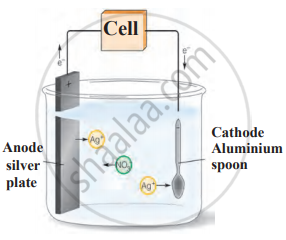
- Name the method.
- Explain the method.
- Give two examples of this method.
What is rust?
The diagram shows the reaction between metal and dil. acid.

What is the reason for different behaviour of Mg in test tube B?
Marble’s popularity began in ancient Rome and Greece, where white and off-white marble were used to construct a variety of structures, from hand-held sculptures to massive pillars and buildings.

The substance not likely to contain CaCO3 is:
State whether the following statement is true or false:
Ships suffer a lot of damage though they are painted.
Gold plated ornaments is the example of ______.
| A process of forming a thick oxide of aluminium when aluminium is exposed to air. This coat makes it resistant to corrosion. Resistance can be improved by making a layer of oxide thinker. In this technique, the aluminium article is the anode, and the electrolyte is sulphuric acid. The anode reaction results in the formation of a black-coloured film of aluminium oxide on the anode. By putting appropriate dyes in the electrolytic solution, both coloured surface with the decorative finish is achieved. Kitchen articles like anodised such as pressure cookers, pans and frames of sliding windows are applications of this technique. |
- Name the anode and electrolyte used in this technique.
- How can we make aluminium articles made resistant to corrosion?
- Name the technique used to coat the aluminium articles.
In ______ process a layer of molten tin is deposited on metals.
