Advertisements
Advertisements
Question
What is meant by 'rusting of iron'? With the help of labelled diagrams, describe an activity to find out the conditions under which iron rusts.
Advertisements
Solution
Iron objects, kept in moist air for a long period of time, react with moist air to form a reddish brown crumbling substance called rust (hydrated iron (III) oxide, Fe2O3. X H2O, where X is the number of moles of water that differs). This corrosion of iron metal by reacting with moist air is called the rusting of iron.
Conditions essential for the rusting of iron:
1. Presence of air (oxygen)
2. Presence of water (moisture)
Let us do an activity to prove that moist air is necessary for the rusting of iron.
Experiment: Take three test tubes and place a dirt-free iron nail in each of these test tubes (refer to the figure below). In the first test tube, anhydrous calcium chloride is added and the test tube is closed. In the second test tube, distilled water and a layer of oil is added and the test tube is closed with a cork. In the third test tube, tap water is added. The nail is dipped into water in such a way that a part of it is exposed to the damp air present inside the test tube.

Observation:
(i) The nails in the first and the second test tube do not rust.
ii) The nail present in the third test tube rusts.
Conclusion:
Hence, we can conclude that both air and water are necessary for the rusting of iron.
APPEARS IN
RELATED QUESTIONS
Write two methods of preventing the rusting of iron.
Choose the correct answer from the options given below:
Heating an ore in a limited supply of air or in the absence of air at a temperature just below its melting point is known as
A. Smelting
B. Ore-dressing
C. Calcination
D. Bessemerisation
Name any two metals which do not corrode easily.
What are the special properties of stainless steel?
Name a common metal which is highly resistant to corrosion.
No chemical reaction takes place when granules of a rusty-brown solid A are mixed with the powder of another solid B. However, when the mixture is heated, a reaction takes place between its components. One of the products C is a metal and settles down in the molten state while the other product D floats over it. It was observed that the reaction is highly exothermic.
(a) What could the solids A and B be?
(b) What are the products C and D most likely to be?
(c) Write the chemical equation for the reaction between A and B leading to the formation of C and D. Mention the physical states of all the reactants and products in this equation and indicate the heat change which takes place.
(d) What is the special name of such a reaction? State one use of such a reaction.
(e) Name any two types of chemical reactions under which the above reaction can be classified.
Name the metal which is a constituent of blood pigment?
Compare roasting and calcination.
Identify the process shown in the diagram and explain it in short

State whether the statement given below is true or false. If false write the correct statement.
Graphite is a lustrous non-metal which conducts electricity.
Observe the following picture and answer the following questions:
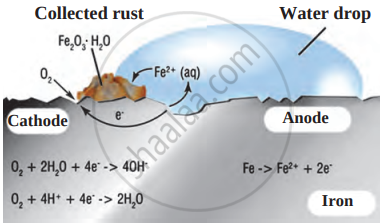
- What is rust?
- Write the chemical formula of rust.
- Write the reaction of oxidation of iron at the anode.
- Write the reaction of oxidation of iron at the cathode.
- What is corrosion?
_______ is an alloy made from iron, carbon and chromium.
Corrosion of silver causes a black layer of _______.
Find the odd one out and give its explanation.
Draw a neat labelled diagram.
Anodizing
Galvanisation is a method of protecting iron from rusting by coating it with a thin layer of ____________.
Explain the following:
Lime water turns milky on passing carbon dioxide gas into it.
Give an example of a chemical reaction for the following situation:
Sound is produced
