Advertisements
Advertisements
Question
Identify the process shown in the diagram and explain it in short

Advertisements
Solution
The process shown in the diagram is Anodization.
In this method metals like copper, aluminium are coated with a thin and strong layer of their oxides by means of electrolysis. For this the copper or aluminium article is used as anode. As this oxide layer is strong and uniform all over the surface, it is useful for prevention of the corrosion of the metal.
APPEARS IN
RELATED QUESTIONS
Tinning : Tin : : Galvanizing : _________
Write two methods of preventing the rusting of iron.
Explain why Iron sheets are coated with zinc during galvanization.
What type of chemical reaction is involved in the corrosion of iron?
The chemical reaction involved in the corrosion of iron metal is that of ______.
State two conditions for the rusting of iron.
The process of depositing a thin layer of zinc on iron articles is called ______.
______ and ______ are necessary for the rusting of iron.
Why is an iron grill painted frequently?
Name any two metals which do not corrode easily.
Name two metals which resist corrosion due to the formation of a thin, hard and impervious layer of oxide on their surface.
In stainless steel alloy, iron metal is mixed with ______.
Four metals P, Q, R and S are all obtained by the reduction of their oxides with carbon. Metal P is used to form a thin layer over the sheets of metal S to prevent its corrosion. Metal Q is used for electroplating tiffin boxes made of metal S whereas metal R is used in making car batteries. Metals Q and R form an alloy called solder. What are metals P, Q, R and S? How have you arrived at this conclusion?
Mention two uses of the following metals and non-metals
Iron
Name the metal which is a constituent of plant pigment?
Corrosion can be an advantage in some case.Explain ?
No chemical reaction takes place when granules of a solid, A, are mixed with the powder of another solid, B. However when the mixture is heated, a reaction takes place between its components. One of the products, C, is a metal and settles down in the molten state while the other product, D, floats over it. It was observed that the reaction is highly exothermic.
(i) Based on the given information make an assumption about A and B and write a chemical equation for the chemical reaction indicating the conditions of reaction, physical state of reactants and products and thermal status of reaction.
(ii) Mention any two types of reactions under which above chemical reaction can be classified.
What is done to prevent corrosion of metals?
Give reason.
A wooden article should be polished.
Explain the term – rusting and give a word equation for the formation of rust. If polished iron nails are kept in three separate test tubes, state the contents in each test tube required, to prove the conditions for rusting.
State whether the statement given below is true or false. If false write the correct statement.
Graphite is a lustrous non-metal which conducts electricity.
Observe the following picture and answer the following questions:
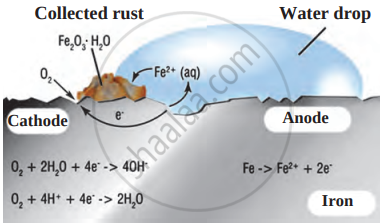
- What is rust?
- Write the chemical formula of rust.
- Write the reaction of oxidation of iron at the anode.
- Write the reaction of oxidation of iron at the cathode.
- What is corrosion?
Which of the following method is used to prevent the accumulation of greenish layer on brass due to corrosion?
Corrosion of silver causes a black layer of _______.
Find the odd one out and give its explanation.
Explain concept with example/explain with the help of a balanced equation.
Corrosion
The process of coating the surface of the metal with a thin layer of zinc is called ______
Give the equation for the formation of rust.
Copper objects lose their shine and form green coating of ____________.
Which among the following alloys contain mercury as one of its constituents?
The table shown below gives information about four substances: A, B, C and D.
| SUBSTANCE | MELTING POINT (K) | ELECTRICAL CONDUCTIVITY | |
| SOLID | LIQUID/ AQUEOUS | ||
| A | 295 | Good | Good |
| B | 1210 | Poor | Good |
| C | 1890 | Poor | Good |
| D | 1160 | Poor | Poor |
Identify Ionic compounds from the above given substances.
Iron pillar near the Qutub Minar in Delhi is famous for the following facts. Which of these facts is responsible for its long stability?
Galvanisation is a process used to prevent the rusting of which of the following?
State whether the following statement is true or false:
Ships suffer a lot of damage though they are painted.
Gold plated ornaments is the example of ______.
Explain the chemical reactions in rusting of iron.
