Advertisements
Advertisements
Questions
Give reasons:
Platinum, gold and silver are used to make jewellery.
Give a reason for the following:
Silver, gold and platinum are used to make jewellery.
Advertisements
Solution
- Gold, silver, and platinum are the least reactive metals. They do not react with air, water, acids, alkalis, or other gases in the environment, so their shine lasts for years.
- Due to their bright lustre and resistance to corrosion, gold, silver, and platinum are used to make jewellery.
APPEARS IN
RELATED QUESTIONS
Tinning : Tin : : Galvanizing : _________
Which metals do not corrode easily?
Explain why Iron sheets are coated with zinc during galvanization.
Name the metal which is used for galvanising iron.
The process of depositing a thin layer of zinc on iron articles is called ______.
Name five methods of preventing rusting of iron.
A common metal which is highly resistant to corrosion is ______.
In stainless steel alloy, iron metal is mixed with ______.
Explain how the activity series accounts for each of the following:
tendency to corrosion
Compare roasting and calcination.
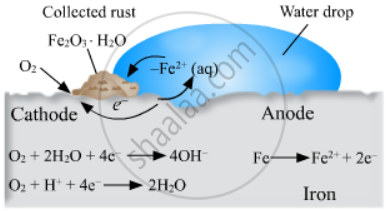
Observe the following picture a write down the chemical reaction with the explanation.
Choose the correct alternative and rewrite the following:
Iron is _____________________.
Rusting of iron : Fe2O3 : : corrosion of copper : ______
Explain concept with example/explain with the help of a balanced equation.
Corrosion
The process of coating the surface of the metal with a thin layer of zinc is called ______
Amalgam is an alloy of ____________.
Iron pillar near the Qutub Minar in Delhi is famous for the following facts. Which of these facts is responsible for its long stability?
| A process of forming a thick oxide of aluminium when aluminium is exposed to air. This coat makes it resistant to corrosion. Resistance can be improved by making a layer of oxide thinker. In this technique, the aluminium article is the anode, and the electrolyte is sulphuric acid. The anode reaction results in the formation of a black-coloured film of aluminium oxide on the anode. By putting appropriate dyes in the electrolytic solution, both coloured surface with the decorative finish is achieved. Kitchen articles like anodised such as pressure cookers, pans and frames of sliding windows are applications of this technique. |
- Name the anode and electrolyte used in this technique.
- How can we make aluminium articles made resistant to corrosion?
- Name the technique used to coat the aluminium articles.
