Advertisements
Advertisements
Question
Explain why, through aluminium is more reactive than iron, yet there is less corrosion of aluminium when both are exposed to air.
Advertisements
Solution
Aluminium is more reactive than iron. It reacts easily with oxygen in moist air and forms a layer of aluminium oxide on its surface. This aluminium oxide layer is very strong and does not allow the air to enter the metal for further reaction. This prevents further corrosion of aluminium. On the other hand, the formation of iron oxide layer by iron on reacting with moist air does not prevent the metal. It further allows the reaction between iron and moist air to continue and increases corrosion. Thus, aluminium is a highly resistive metal to corrosion and protects itself against corrosion as compared to iron when exposed to air.
APPEARS IN
RELATED QUESTIONS
Name any three objects (or structures) which are gradually damaged by the corrosion of iron and steel.
What is meant by galvanisation? Why is it done?
Fill in the following blank with suitable word:
The process of depositing a thin layer of zinc on iron articles is called .............
Give the constituents and one use of brass.
Name two metals which resist corrosion due to the formation of a thin, hard and impervious layer of oxide on their surface.
Name a common metal which is highly resistant to corrosion.
Explain how the activity series accounts for each of the following:
tendency to corrosion
Corrosion can be an advantage in some case.Explain ?
Answer the following question:
What is corrosion? Do gold ornaments corrode? Justify.
Pressure cooker : Anodizing : : Silver plated spoons : _______
Find the odd one out and give its explanation.
Write scientific reason.
On exposure to air, silver articles turn blackish after some time.
Draw a neat labelled diagram.
Electroplating
Complete flow chart given below.
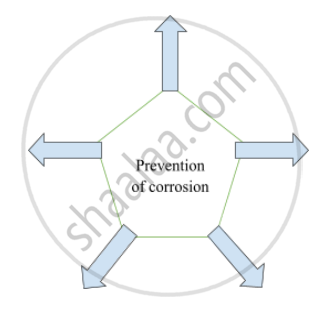
Observe the following diagram and write answers.
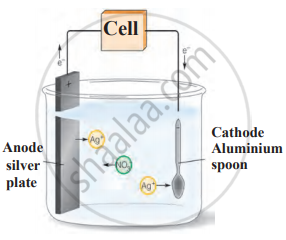
- Name the method.
- Explain the method.
- Give two examples of this method.
Give the equation for the formation of rust.
Galvanisation is a method of protecting iron from rusting by coating it with a thin layer of ____________.
The diagram shows the reaction between metal and dil. acid.

What is the reason for different behaviour of Mg in test tube B?
Generally, when metals are treated with mineral acids, hydrogen gas is liberated but when metals (except Mn and Mg), treated with HNO3, hydrogen is not liberated, why?
State whether the following statement is true or false:
Ships suffer a lot of damage though they are painted.
