Advertisements
Advertisements
प्रश्न
Explain why, through aluminium is more reactive than iron, yet there is less corrosion of aluminium when both are exposed to air.
Advertisements
उत्तर
Aluminium is more reactive than iron. It reacts easily with oxygen in moist air and forms a layer of aluminium oxide on its surface. This aluminium oxide layer is very strong and does not allow the air to enter the metal for further reaction. This prevents further corrosion of aluminium. On the other hand, the formation of iron oxide layer by iron on reacting with moist air does not prevent the metal. It further allows the reaction between iron and moist air to continue and increases corrosion. Thus, aluminium is a highly resistive metal to corrosion and protects itself against corrosion as compared to iron when exposed to air.
APPEARS IN
संबंधित प्रश्न
What is an alloy?
State two conditions for the rusting of iron.
Fill in the following blanks with suitable words:
Tiffin boxes are electroplated with .............. but car bumpers are electroplated with ............... to protect them from rusting.
Name any two metals which do not corrode easily.
In stainless steel alloy, iron metal is mixed with:
(a) Cu and Cr
(b) Cr and Ni
(c) Cr and Sn
(d) Cu and Ni
Mention two uses of the following metals and non-metals
Iron
Name the metal which is a constituent of blood pigment?
Answer the following question.
a) What is meant by corrosion?
b) Write names of any two methods of prevention of corrosion.
c) In which method, metal like copper, aluminium are coated with a thin layer of their oxides by means of electrolysis.
d) Explain this method with diagram.
_______ is an alloy made from iron, carbon and chromium.
Corrosion of silver causes a black layer of _______.
To prevent corrosion of iron and steel _______ method is used.
When one of the metals in an alloy is mercury the alloy is called _______.
Bronze : _______ : : Stainless steel : Fe + Cr + C
Find the odd one out and give its explanation.
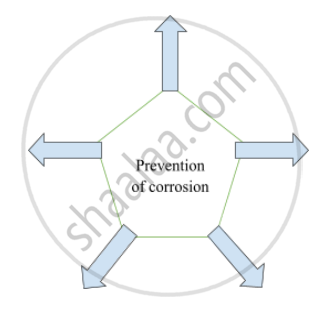
Complete flow chart given below.
State two conditions necessary for rusting of iron.
A man painted his main gate made up of iron, to
- prevent it from rusting.
- protect it from sun.
- make it look beautiful.
- make it dust free.
Which of the above statement(s) is/are correct?
Galvanisation is a process used to prevent the rusting of which of the following?
Give an example of a chemical reaction for the following situation:
Sound is produced
Explain the chemical reactions in rusting of iron.
