Advertisements
Advertisements
प्रश्न
Explain why, through aluminium is more reactive than iron, yet there is less corrosion of aluminium when both are exposed to air.
Advertisements
उत्तर
Aluminium is more reactive than iron. It reacts easily with oxygen in moist air and forms a layer of aluminium oxide on its surface. This aluminium oxide layer is very strong and does not allow the air to enter the metal for further reaction. This prevents further corrosion of aluminium. On the other hand, the formation of iron oxide layer by iron on reacting with moist air does not prevent the metal. It further allows the reaction between iron and moist air to continue and increases corrosion. Thus, aluminium is a highly resistive metal to corrosion and protects itself against corrosion as compared to iron when exposed to air.
APPEARS IN
संबंधित प्रश्न
Give two examples of alloys with their chemical composition.
Which metals do not corrode easily?
Two methods by which rusting of iron can be prevented are ______ and ______.
Explain why, iron sheets are coated with zinc.
In one method of rust prevention, the iron is not coated with anything. Which is this method?
Name a common metal which is highly resistant to corrosion.
Brass is an alloy of:
(a) Cu and Sn
(b) Cu and Pb
(c) Pb and Sn
(d) Zn and Cu
Find the odd man out:
What is done to prevent corrosion of metals?
What are the adverse effects of corrosion?
Answer the following question.
List two properties of alloys.
Observe the following picture and answer the following questions:
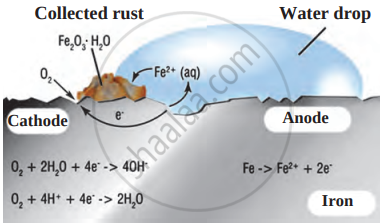
- What is rust?
- Write the chemical formula of rust.
- Write the reaction of oxidation of iron at the anode.
- Write the reaction of oxidation of iron at the cathode.
- What is corrosion?
Corrosion of silver causes a black layer of _______.
_______ forms a green colour in the water.
Find the odd one out and give its explanation.
Give preventive methods by giving examples of corrosion?
Generally, when metals are treated with mineral acids, hydrogen gas is liberated but when metals (except Mn and Mg), treated with HNO3, hydrogen is not liberated, why?
Give an example of a chemical reaction for the following situation:
Sound is produced
| A process of forming a thick oxide of aluminium when aluminium is exposed to air. This coat makes it resistant to corrosion. Resistance can be improved by making a layer of oxide thinker. In this technique, the aluminium article is the anode, and the electrolyte is sulphuric acid. The anode reaction results in the formation of a black-coloured film of aluminium oxide on the anode. By putting appropriate dyes in the electrolytic solution, both coloured surface with the decorative finish is achieved. Kitchen articles like anodised such as pressure cookers, pans and frames of sliding windows are applications of this technique. |
- Name the anode and electrolyte used in this technique.
- How can we make aluminium articles made resistant to corrosion?
- Name the technique used to coat the aluminium articles.
