Advertisements
Advertisements
प्रश्न
What is corrosion?
Give a brief account of corrosion.
What is meant by corrosion?
Advertisements
उत्तर
Corrosion is the damage caused to the metal by the chemical reaction of air, water, and acids with the surface of the metal. Generally, reactive metals corrode easily, and non-reactive metals have good resistance to corrosion.
APPEARS IN
संबंधित प्रश्न
Tinning : Tin : : Galvanizing : _________
Write two methods of preventing the rusting of iron.
Why do we apply paint on iron articles?
Explain the term corrosion.
Give reasons:
Platinum, gold and silver are used to make jewellery.
Choose the correct answer from the options given below:
Heating an ore in a limited supply of air or in the absence of air at a temperature just below its melting point is known as
A. Smelting
B. Ore-dressing
C. Calcination
D. Bessemerisation
What type of chemical reaction is involved in the corrosion of iron?
The chemical reaction involved in the corrosion of iron metal is that of ______.
What is meant by galvanisation? Why is it done?
Name the metal which is used for galvanising iron.
Explain why, iron sheets are coated with zinc.
The corrosion of iron is called ______.
Name any two metals which do not corrode easily.
What is the corrosion of iron known as?
What are the special properties of stainless steel?
Explain why, the galvanised iron article is protected against rusting even if the zinc layer is broken.
A common metal which is highly resistant to corrosion is ______.
Four metals P, Q, R and S are all obtained by the reduction of their oxides with carbon. Metal P is used to form a thin layer over the sheets of metal S to prevent its corrosion. Metal Q is used for electroplating tiffin boxes made of metal S whereas metal R is used in making car batteries. Metals Q and R form an alloy called solder. What are metals P, Q, R and S? How have you arrived at this conclusion?
Mention two uses of the following metals and non-metals
Iron
Bronze is an alloy of ______.
Name the metal which is a constituent of plant pigment?
Explain how the activity series accounts for each of the following:
tendency to corrosion
What is corrosion? What are necessary conditions for corrosion?
State under what conditions corrosion is faster ?
Corrosion can be an advantage in some case.Explain ?
Explain with reason:
Roasting is carried out on sulphide ores and not on carbonate ores.
Write scientific reasons.
Lemon or tamarind is used for cleaning copper vessels turned greenish.
Answer the following question.
a) What is meant by corrosion?
b) Write names of any two methods of prevention of corrosion.
c) In which method, metal like copper, aluminium are coated with a thin layer of their oxides by means of electrolysis.
d) Explain this method with diagram.
What is done to prevent corrosion of metals?
What are the adverse effects of corrosion?
Answer the following question:
What is corrosion? Do gold ornaments corrode? Justify.
What is ‘rusting’?
Explain the term – rusting and give a word equation for the formation of rust. If polished iron nails are kept in three separate test tubes, state the contents in each test tube required, to prove the conditions for rusting.
Write a short note on Alloying.
To prevent corrosion of iron and steel _______ method is used.
Pressure cooker : Anodizing : : Silver plated spoons : _______
Find the correlation:
Bronze : ______ :: Tin : Cu+Zn.
Find the odd one out and give its explanation.
Find the odd one out and give its explanation.
Write scientific reason.
Anodization method is useful for prevention of the corrosion of the aluminium.
Write scientific reason.
On exposure to air, silver articles turn blackish after some time.
Explain concept with example/explain with the help of a balanced equation.
Corrosion
Draw a neat labelled diagram.
Anodizing
What is rust?
Observe the following diagram and give answers.
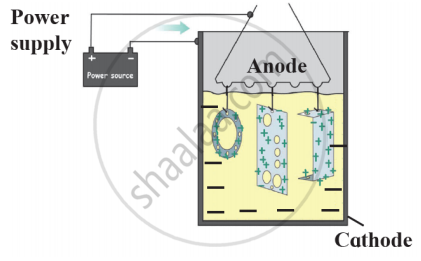
- Name this method of prevention of corrosion.
- For prevention of which metal this method is used?
- What is used as anode in this method?
Observe the following diagram and write answers.
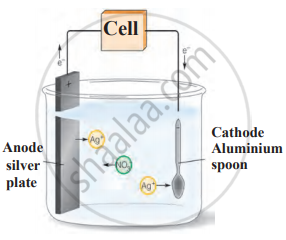
- Name the method.
- Explain the method.
- Give two examples of this method.
Observe the following figure and write the answer of the question.
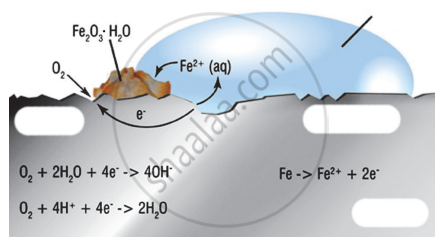
- Which process is shown in the figure?
- Explain the chemical reaction shown in the figure.
- Write the reactions on anode and cathode.
Give solutions by giving examples of corrosion?
Galvanisation is a method of protecting iron from rusting by coating it with a thin layer of ____________.
| A process of forming a thick oxide of aluminium when aluminium is exposed to air. This coat makes it resistant to corrosion. Resistance can be improved by making a layer of oxide thinker. In this technique, the aluminium article is the anode, and the electrolyte is sulphuric acid. The anode reaction results in the formation of a black-coloured film of aluminium oxide on the anode. By putting appropriate dyes in the electrolytic solution, both coloured surface with the decorative finish is achieved. Kitchen articles like anodised such as pressure cookers, pans and frames of sliding windows are applications of this technique. |
- Name the anode and electrolyte used in this technique.
- How can we make aluminium articles made resistant to corrosion?
- Name the technique used to coat the aluminium articles.
In ______ process a layer of molten tin is deposited on metals.
Describe two changes that are harmful. Explain why you consider them harmful. How can you prevent them?
