Advertisements
Advertisements
प्रश्न
A metal X which is resistant to corrosion is produced by the electrolysis of its molten oxide whereas another metal Y which is also resistant to corrosion is produced by the reduction of its oxide with carbon. Metal X can be used in powder form in thermite welding whereas metal Y is used in making cathodes of ordinary dry cells.
(a) Name the metals X and Y.
(b) Which of the two metals is more reactive : X or Y?
(c) Name one ore or metal X. Also write its chemical formula.
(d) Name one ore or metal Y. Also write its chemical formula.
(e) Name one alloy of metal X and one alloy of metal Y.
Advertisements
उत्तर
(a) Metal X is aluminium and metal Y is zinc.
Metal X or aluminium is resistant to corrosion and is produced by electrolysis of molten aluminium oxide. Aluminium is used in thermite welding.
Metal Y or zinc is also resistant to corrosion and is produced by reduction of zinc oxide with carbon (reducing agent). Zinc is widely used in making cathodes of ordinary dry cells.
(b) X (aluminium) is more reactive than Y (zinc). Aluminium is placed above zinc in the reactivity series.
(c) One ore of metal X (aluminium) is bauxite ore. The chemical formula of bauxite ore is Al2O3.2H2O.
(d) One ore of metal Y (zinc) is calamine ore. The chemical formula of calamine ore is ZnCO3.
(e) One alloy of metal X (aluminium) is magnalium, which consists of aluminium and magnesium. One alloy of metal Y (zinc) is brass, which consists of zinc and copper.
APPEARS IN
संबंधित प्रश्न
Why do we apply paint on iron articles?
Write a chemical equation to show the process of corrosion of iron.
Name any three objects (or structures) which are gradually damaged by the corrosion of iron and steel.
What is meant by galvanisation? Why is it done?
Name the metal which is used for galvanising iron.
Explain why, iron sheets are coated with zinc.
What is the corrosion of iron known as?
What are the constituents of stainless steel?
No chemical reaction takes place when granules of a rusty-brown solid A are mixed with the powder of another solid B. However, when the mixture is heated, a reaction takes place between its components. One of the products C is a metal and settles down in the molten state while the other product D floats over it. It was observed that the reaction is highly exothermic.
(a) What could the solids A and B be?
(b) What are the products C and D most likely to be?
(c) Write the chemical equation for the reaction between A and B leading to the formation of C and D. Mention the physical states of all the reactants and products in this equation and indicate the heat change which takes place.
(d) What is the special name of such a reaction? State one use of such a reaction.
(e) Name any two types of chemical reactions under which the above reaction can be classified.
Explain how the activity series accounts for each of the following:
tendency to corrosion
What is corrosion? What are necessary conditions for corrosion?
Corrosion can be an advantage in some case.Explain ?
Write three methods of preventing rusting of iron.
Observe the following picture and answer the following questions:
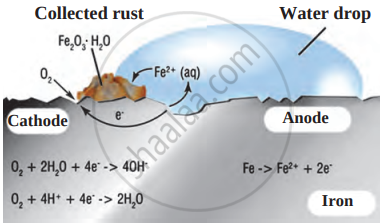
- What is rust?
- Write the chemical formula of rust.
- Write the reaction of oxidation of iron at the anode.
- Write the reaction of oxidation of iron at the cathode.
- What is corrosion?
Explain concept with example/explain with the help of a balanced equation.
Corrosion
Observe the following figure and write the answer of the question.
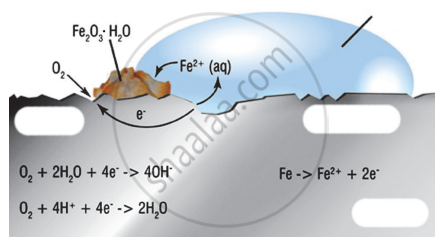
- Which process is shown in the figure?
- Explain the chemical reaction shown in the figure.
- Write the reactions on anode and cathode.
Identify the correct statement from the following:
Generally, when metals are treated with mineral acids, hydrogen gas is liberated but when metals (except Mn and Mg), treated with HNO3, hydrogen is not liberated, why?
