Advertisements
Advertisements
प्रश्न
Bronze is an alloy of ______.
विकल्प
copper and tin
copper and zinc
tin and zinc
copper, zinc and tin
Advertisements
उत्तर
Bronze is an alloy of copper and tin.
Explanation:
Bronze is a solid alloy composed primarily of 88% copper and 12% tin. It is used in the production of hardware, utensils musical instruments, medals, and other items. Due to its resistance to corrosion caused by seawater, it is used in submerged bearings and ship propellants.
APPEARS IN
संबंधित प्रश्न
Write two methods of preventing the rusting of iron.
Which metals do not corrode easily?
Give reasons:
Platinum, gold and silver are used to make jewellery.
Explain how painting of an iron gate prevents it from rusting.
Choose the correct answer from the options given below:
Heating an ore in a limited supply of air or in the absence of air at a temperature just below its melting point is known as
A. Smelting
B. Ore-dressing
C. Calcination
D. Bessemerisation
Explain the term “corrosion” with an example. Write a chemical equation to show the process of corrosion of iron.
Name any three objects (or structures) which are gradually damaged by the corrosion of iron and steel.
Name the metal which is used for galvanising iron.
In one method of rust prevention, the iron is not coated with anything. Which is this method?
The corrosion of iron is called ______.
What is the corrosion of iron known as?
Name two metals which resist corrosion due to the formation of a thin, hard and impervious layer of oxide on their surface.
Name five methods of preventing rusting of iron.
Name an alloy of copper. State its chemical composition and any one use.
Explain why, when a copper object remains in damp air for a considerable time, a green coating is formed on its surface. What is this process known as?
A common metal which is highly resistant to corrosion is ______.
A metal X which is resistant to corrosion is produced by the electrolysis of its molten oxide whereas another metal Y which is also resistant to corrosion is produced by the reduction of its oxide with carbon. Metal X can be used in powder form in thermite welding whereas metal Y is used in making cathodes of ordinary dry cells.
- Name the metals X and Y.
- Which of the two metals is more reactive: X or Y?
- Name one ore or metal X. Also write its chemical formula.
- Name one ore of metal Y. Also write its chemical formula.
- Name one alloy of metal X and one alloy of metal Y.
Mention two uses of the following metals and non-metals
Iron
Name the metal which is a constituent of plant pigment?
Corrosion can be an advantage in some case.Explain ?
Explain with reason:
Roasting is carried out on sulphide ores and not on carbonate ores.
No chemical reaction takes place when granules of a solid, A, are mixed with the powder of another solid, B. However when the mixture is heated, a reaction takes place between its components. One of the products, C, is a metal and settles down in the molten state while the other product, D, floats over it. It was observed that the reaction is highly exothermic.
(i) Based on the given information make an assumption about A and B and write a chemical equation for the chemical reaction indicating the conditions of reaction, physical state of reactants and products and thermal status of reaction.
(ii) Mention any two types of reactions under which above chemical reaction can be classified.
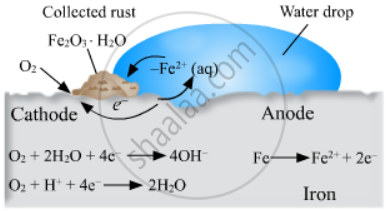
Observe the following picture a write down the chemical reaction with the explanation.
Find the odd man out:
What are the adverse effects of corrosion?
Choose the correct alternative and rewrite the following:
Iron is _____________________.
What is ‘rusting’?
Give reason.
An iron article should be given a coat of paint
Give reason.
Copper and brass utensils should be tinned.
Give a reason why rust turns moist red litmus blue.
Give reason for the following:
A suspension of rust is basic in nature.
Write a short note on Alloying.
Observe the following picture and answer the following questions:
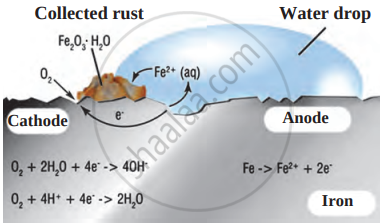
- What is rust?
- Write the chemical formula of rust.
- Write the reaction of oxidation of iron at the anode.
- Write the reaction of oxidation of iron at the cathode.
- What is corrosion?
To prevent corrosion of iron and steel _______ method is used.
_______ forms a green colour in the water.
Find the correlation:
Bronze : ______ :: Tin : Cu+Zn.
Find the odd one out and give its explanation.
Write scientific reason.
Coins are made from metals and alloys.
Draw a neat labelled diagram.
Electrolysis
Draw a neat labelled diagram.
Anodizing
Complete flow chart given below.
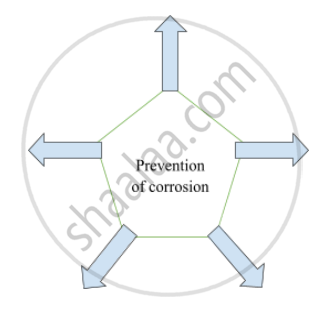
Give solutions by giving examples of corrosion?
What is rust?
State two conditions necessary for rusting of iron.
Galvanisation is a method of protecting iron from rusting by coating it with a thin layer of ____________.
Amalgam is an alloy of ____________.
The table shown below gives information about four substances: A, B, C and D.
| SUBSTANCE | MELTING POINT (K) | ELECTRICAL CONDUCTIVITY | |
| SOLID | LIQUID/ AQUEOUS | ||
| A | 295 | Good | Good |
| B | 1210 | Poor | Good |
| C | 1890 | Poor | Good |
| D | 1160 | Poor | Poor |
Identify Ionic compounds from the above given substances.
Marble’s popularity began in ancient Rome and Greece, where white and off-white marble were used to construct a variety of structures, from hand-held sculptures to massive pillars and buildings.

The substance not likely to contain CaCO3 is:
Iron pillar near the Qutub Minar in Delhi is famous for the following facts. Which of these facts is responsible for its long stability?
Galvanisation is a process used to prevent the rusting of which of the following?
State whether the following statement is true or false:
Ships suffer a lot of damage though they are painted.
Explain the following:
Lime water turns milky on passing carbon dioxide gas into it.
Explain the following:
Bubbles are produced when acetic acid is added to a solution of sodium hydrogencarbonate.
| A process of forming a thick oxide of aluminium when aluminium is exposed to air. This coat makes it resistant to corrosion. Resistance can be improved by making a layer of oxide thinker. In this technique, the aluminium article is the anode, and the electrolyte is sulphuric acid. The anode reaction results in the formation of a black-coloured film of aluminium oxide on the anode. By putting appropriate dyes in the electrolytic solution, both coloured surface with the decorative finish is achieved. Kitchen articles like anodised such as pressure cookers, pans and frames of sliding windows are applications of this technique. |
- Name the anode and electrolyte used in this technique.
- How can we make aluminium articles made resistant to corrosion?
- Name the technique used to coat the aluminium articles.
In ______ process a layer of molten tin is deposited on metals.
