Advertisements
Advertisements
प्रश्न
Explain the following:
Bubbles are produced when acetic acid is added to a solution of sodium hydrogencarbonate.
Advertisements
उत्तर
When acetic acid is added to a solution of sodium hydrogencarbonate, carbon dioxide gas is formed which comes out in the form of bubbles.
Sodium hydrogencarbonate + Acetic acid → Sodium carbonate + Water + Carbon dioxide
APPEARS IN
संबंधित प्रश्न
What are alloys?
The process of depositing a thin layer of zinc on iron articles is called ______.
Name the metal which is a constituent of blood pigment?
Find the odd one out and give its explanation.
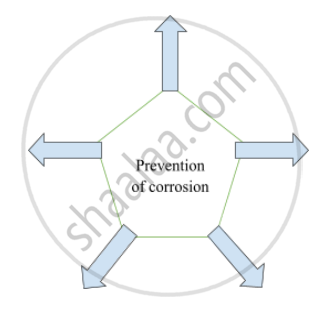
Complete flow chart given below.
Alloys are homogeneous mixtures of a metal with a metal or non-metal. Which among the following alloys contain non-metal as one of its constituents?
Galvanisation is a process used to prevent the rusting of which of the following?
Give scientific reasons.
Silver amalgam is used for filling dental cavities.
| A process of forming a thick oxide of aluminium when aluminium is exposed to air. This coat makes it resistant to corrosion. Resistance can be improved by making a layer of oxide thinker. In this technique, the aluminium article is the anode, and the electrolyte is sulphuric acid. The anode reaction results in the formation of a black-coloured film of aluminium oxide on the anode. By putting appropriate dyes in the electrolytic solution, both coloured surface with the decorative finish is achieved. Kitchen articles like anodised such as pressure cookers, pans and frames of sliding windows are applications of this technique. |
- Name the anode and electrolyte used in this technique.
- How can we make aluminium articles made resistant to corrosion?
- Name the technique used to coat the aluminium articles.
Describe two changes that are harmful. Explain why you consider them harmful. How can you prevent them?
