Advertisements
Advertisements
Question
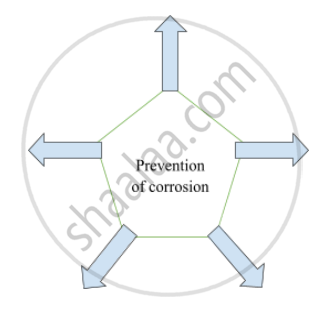
Complete flow chart given below.
Advertisements
Solution

APPEARS IN
RELATED QUESTIONS
Which of the following methods is suitable for preventing an iron frying pan from rusting?
Give reasons:
Platinum, gold and silver are used to make jewellery.
Choose the correct answer from the options given below:
Heating an ore in a limited supply of air or in the absence of air at a temperature just below its melting point is known as
A. Smelting
B. Ore-dressing
C. Calcination
D. Bessemerisation
What is anodising? Give its applications.
The chemical reaction involved in the corrosion of iron metal is that of ______.
What is corrosion?
Name any two metals which do not corrode easily.
Name two metals which resist corrosion due to the formation of a thin, hard and impervious layer of oxide on their surface.
Name five methods of preventing rusting of iron.
Name an alloy of copper. State its chemical composition and any one use.
Corrosion can be an advantage in some case.Explain ?
Explain with reason:
Roasting is carried out on sulphide ores and not on carbonate ores.
Complete the process of iron rusting by filling the blanks. Suggest a way to prohibit the process.
The iron rust is formed due to........................... reaction. Different
regions on iron surface become anode and cathode.
Reaction on anode region :
`F_e(s) → Fe^(2+) (aq) +2e^-`
Reaction on anode region :
`O_2(g) + 4H^+(aq) +............................ → 2H_2 O (l) `
When Fe2+ ions migrate from anode region they react with ................... to form Fe3+ ions.
A reddish coloured hydrated oxide is formed from ............... ions. It is called rust.
`2Fe_(3+) (aq) + 4H_2O(l) → ................. + 6H_+(aq) `
A way to prevent rusting ..................................................................
Identify the process shown in the diagram and explain it in short

Choose the correct alternative and rewrite the following:
Iron is _____________________.
Write three methods of preventing rusting of iron.
Give reason.
A wooden article should be polished.
Explain the term – rusting and give a word equation for the formation of rust. If polished iron nails are kept in three separate test tubes, state the contents in each test tube required, to prove the conditions for rusting.
State whether the statement given below is true or false. If false write the correct statement.
Graphite is a lustrous non-metal which conducts electricity.
_______ forms a green colour in the water.
Stainless steel is an alloy of _______.
Rusting of iron : Fe2O3 : : corrosion of copper : ______
Find the odd one out and give its explanation.
Match the columns.
| Group A | Group B |
| 1) Electroplating | a) Pressure cooker |
| 2) Anodising | b) Silver plated spoons |
| c) Coating of tin on copper | |
| d) Coating of Zinc on iron |
Write the name.
An alloy of copper and tin-
Write scientific reason.
Anodization method is useful for prevention of the corrosion of the aluminium.
Write scientific reason.
Coins are made from metals and alloys.
Explain concept with example/explain with the help of a balanced equation.
Corrosion
Write a molecular formula for rust.
Observe the following figure and write the answer of the question.
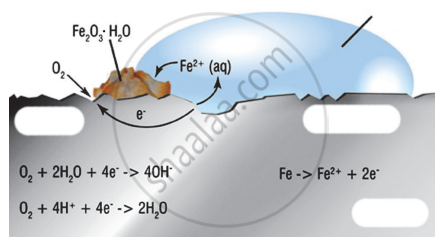
- Which process is shown in the figure?
- Explain the chemical reaction shown in the figure.
- Write the reactions on anode and cathode.
Which among the following alloys contain mercury as one of its constituents?
Marble’s popularity began in ancient Rome and Greece, where white and off-white marble were used to construct a variety of structures, from hand-held sculptures to massive pillars and buildings.

The substance not likely to contain CaCO3 is:
Identify the correct statement from the following:
Alloys are homogeneous mixtures of a metal with a metal or non-metal. Which among the following alloys contain non-metal as one of its constituents?
Galvanisation is a process used to prevent the rusting of which of the following?
Explain the following:
Lime water turns milky on passing carbon dioxide gas into it.
Give an example of a chemical reaction for the following situation:
Sound is produced
