Advertisements
Advertisements
प्रश्न
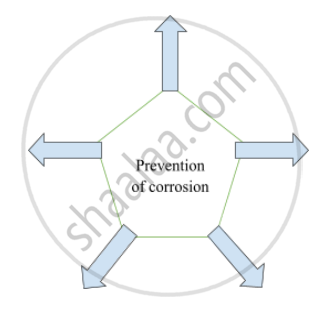
Complete flow chart given below.
Advertisements
उत्तर

APPEARS IN
संबंधित प्रश्न
What is an alloy?
Give two examples of alloys with their chemical composition.
Write two methods of preventing the rusting of iron.
Explain the term corrosion.
What are alloys?
Which of the following methods is suitable for preventing an iron frying pan from rusting?
Explain why rusting of iron objects is faster in coastal areas than in deserts.
Choose the correct answer from the options given below:
Heating an ore in a limited supply of air or in the absence of air at a temperature just below its melting point is known as
A. Smelting
B. Ore-dressing
C. Calcination
D. Bessemerisation
Name the metal which is used for galvanising iron.
State two conditions for the rusting of iron.
The corrosion of copper produces a ______ coating of basic copper carbonate on its surface.
______ and ______ are necessary for the rusting of iron.
What is corrosion?
Name any two metals which do not corrode easily.
Name two metals which resist corrosion due to the formation of a thin, hard and impervious layer of oxide on their surface.
Name five methods of preventing rusting of iron.
Explain why, the galvanised iron article is protected against rusting even if the zinc layer is broken.
Mention two uses of the following metals and non-metals
Iron
Compare roasting and calcination.
No chemical reaction takes place when granules of a solid, A, are mixed with the powder of another solid, B. However when the mixture is heated, a reaction takes place between its components. One of the products, C, is a metal and settles down in the molten state while the other product, D, floats over it. It was observed that the reaction is highly exothermic.
(i) Based on the given information make an assumption about A and B and write a chemical equation for the chemical reaction indicating the conditions of reaction, physical state of reactants and products and thermal status of reaction.
(ii) Mention any two types of reactions under which above chemical reaction can be classified.
Answer the following question:
What is corrosion? Do gold ornaments corrode? Justify.
Give reason.
An iron article should be given a coat of paint
Write a short note on Alloying.
Which of the following method is used to prevent the accumulation of greenish layer on brass due to corrosion?
When one of the metals in an alloy is mercury the alloy is called _______.
Draw a neat labelled diagram.
Electrolysis
Give solutions by giving examples of corrosion?
Give the equation for the formation of rust.
Galvanisation is a method of protecting iron from rusting by coating it with a thin layer of ____________.
The diagram shows the reaction between metal and dil. acid.

What is the reason for different behaviour of Mg in test tube B?
Iron pillar near the Qutub Minar in Delhi is famous for the following facts. Which of these facts is responsible for its long stability?
Give an example of a chemical reaction for the following situation:
Sound is produced
In ______ process a layer of molten tin is deposited on metals.
