Advertisements
Advertisements
प्रश्न
Explain concept with example/explain with the help of a balanced equation.
Corrosion
Advertisements
उत्तर
- The process of slow degradation of the metals due to the attack of atmospheric gases, moisture, acids, etc. on the surface of metals is called corrosion.
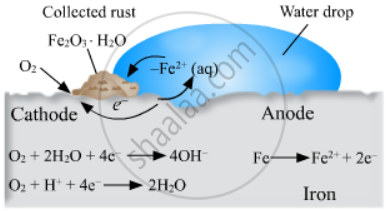
- Iron reacts with moist air and a deposit of reddish substance (Fe2O3.H2O) is formed on it. This substance is called rust and the corrosion of iron is known as rusting.
- Carbon dioxide in moist air reacts with the surface of copper vessel. Copper loses its lustre due to formation of a greenish layer of copper carbonate (CuCO3) on its surface. This is called patination of copper.
- Various methods such as galvanizing, tinning, alloying, etc. are used to protect metals from corrosion.
APPEARS IN
संबंधित प्रश्न
Give two examples of alloys with their chemical composition.
Which metals do not corrode easily?
Which of the following methods is suitable for preventing an iron frying pan from rusting?
Explain how painting of an iron gate prevents it from rusting.
Explain why Iron sheets are coated with zinc during galvanization.
State two conditions for the rusting of iron.
The corrosion of copper produces a ______ coating of basic copper carbonate on its surface.
Name any two metals which do not corrode easily.
Give the constituents of brass.
What are the special properties of stainless steel?
Brass is an alloy of ______.
No chemical reaction takes place when granules of a rusty-brown solid A are mixed with the powder of another solid B. However, when the mixture is heated, a reaction takes place between its components. One of the products C is a metal and settles down in the molten state while the other product D floats over it. It was observed that the reaction is highly exothermic.
- What could the solids A and B be?
- What are the products C and D most likely to be?
- Write the chemical equation for the reaction between A and B leading to the formation of C and D. Mention the physical states of all the reactants and products in this equation and indicate the heat change which takes place.
- What is the special name of such a reaction? State one use of such a reaction.
- Name any two types of chemical reactions under which the above reaction can be classified.
Name the metal which is a constituent of plant pigment?
Explain how the activity series accounts for each of the following:
tendency to corrosion
What is corrosion? What are necessary conditions for corrosion?
Compare roasting and calcination.
Observe the following picture a write down the chemical reaction with the explanation.
Find the odd man out:
What is ‘rusting’?
Observe the following picture and answer the following questions:
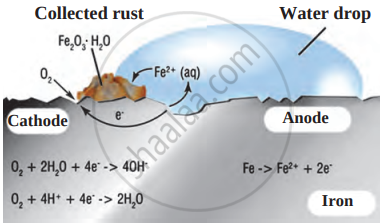
- What is rust?
- Write the chemical formula of rust.
- Write the reaction of oxidation of iron at the anode.
- Write the reaction of oxidation of iron at the cathode.
- What is corrosion?
Pressure cooker : Anodizing : : Silver plated spoons : _______
Find the odd one out and give its explanation.
Find the odd one out and give its explanation.
Write scientific reason.
On exposure to air, silver articles turn blackish after some time.
Write a molecular formula for rust.
Observe the following diagram and give answers.
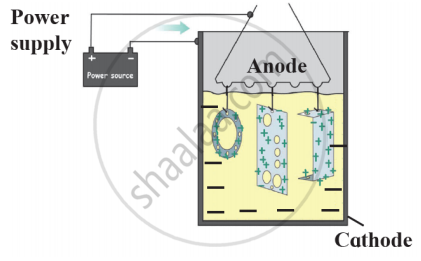
- Name this method of prevention of corrosion.
- For prevention of which metal this method is used?
- What is used as anode in this method?
The process of coating the surface of the metal with a thin layer of zinc is called ______
State two conditions necessary for rusting of iron.
Copper objects lose their shine and form green coating of ____________.
Which among the following alloys contain mercury as one of its constituents?
The table shown below gives information about four substances: A, B, C and D.
| SUBSTANCE | MELTING POINT (K) | ELECTRICAL CONDUCTIVITY | |
| SOLID | LIQUID/ AQUEOUS | ||
| A | 295 | Good | Good |
| B | 1210 | Poor | Good |
| C | 1890 | Poor | Good |
| D | 1160 | Poor | Poor |
Identify Ionic compounds from the above given substances.
A man painted his main gate made up of iron, to
- prevent it from rusting.
- protect it from sun.
- make it look beautiful.
- make it dust free.
Which of the above statement(s) is/are correct?
Explain the following:
Bubbles are produced when acetic acid is added to a solution of sodium hydrogencarbonate.
Give an example of a chemical reaction for the following situation:
Sound is produced
Describe two changes that are harmful. Explain why you consider them harmful. How can you prevent them?
