Advertisements
Advertisements
प्रश्न
Explain concept with example/explain with the help of a balanced equation.
Minerals
Advertisements
उत्तर
- Most metals being reactive do not occur in nature in the free state but are found in a combined state as their salts such as oxides, carbonates, sulphides, and nitrates.
- However, some unreactive metals like silver, gold, platinum, generally occur in a free state.
- The compounds of metals that occur in nature along with the impurities are called minerals.
- For example, bauxite is a mineral of aluminium.
APPEARS IN
संबंधित प्रश्न
Why are alkali metals kept in kerosene oil?
Metal A has an electronic configuration of 2, 8, 1 and metal B has 2, 8, 8, 2 which is more reactive metal.
Give the effect of heat on their ?
oxides
Explain the following term:
Gangue
Explain the following terms:
smelting
With a labelled diagram, explain the electro-refining of a particular metal.
`Ag2O` ................................
`MnO_2 + 4Al`  …………….
`ZnCO_3` ..............................
Give the ionization reactions of electrolyte used in Hall’s process. write the reaction at the cathode and the anode. Why the anode has to be replaced in this process?
Why is flux used in the blast furnace?
How is it removed?
Which metal is used for:
making pipes, buckets, water tanks,
What is magnalium? Name the main elements present in it? Write its one use ?
Explain the term Metallurgy.
Write the molecular formulae of the following compound.
Ferrous tungstate
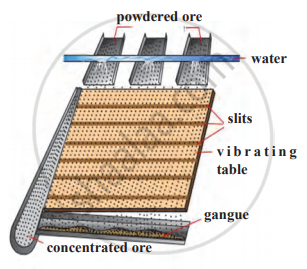
Identify the following method of concentration of ores and explain briefly.
State the reason for the addition of caustic alkali to bauxite ore during the purification of bauxite.
Calcination is used in metallurgy for the removal of?
Identify false statement regarding lithium aluminium hydride?
