Advertisements
Advertisements
Question
Explain concept with example/explain with the help of a balanced equation.
Minerals
Advertisements
Solution
- Most metals being reactive do not occur in nature in the free state but are found in a combined state as their salts such as oxides, carbonates, sulphides, and nitrates.
- However, some unreactive metals like silver, gold, platinum, generally occur in a free state.
- The compounds of metals that occur in nature along with the impurities are called minerals.
- For example, bauxite is a mineral of aluminium.
APPEARS IN
RELATED QUESTIONS
brown powder deposit on iron?
`ZnCO_3` ..............................
`2Pb(NO3)_2` .........................
`2AgNO_3` ...........................
`2Cu_2O +Cu_2S` ......................
`HgS + O_2` ..................
Give the ionization reactions of electrolyte used in Hall’s process. write the reaction at the cathode and the anode. Why the anode has to be replaced in this process?
Where are the cathode and anode in the electrolytic cell? Name the material used for these?
Distinguish between electrolytic methods of reduction and refining.
Which metal is used for:
making pipes, buckets, water tanks,
What is magnalium? Name the main elements present in it? Write its one use ?
The following is a sketch of an electrolytic cell used in the extraction of aluminium :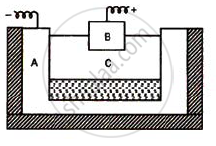
(a) What is the substance of which the electrode A and B are made?
(b) At which electrode (A or B) is aluminium formed?
(c) What are the two aluminium compounds in the electrolyte C?
(d) Why is it necessary for electrode B to be continuously replaced?
What do you observe when hydrogen is passed over heated copper oxide?
Write scientific reason.
Magnetic separation method is used to separate the magnetic ingredients in the ores.
Distinguish between:
Froth floatation - Leaching
Explain the froth floatation method with a neat labelled diagram.
Which of the following methods is used to separate wolframite and stannic oxide present in cassiterite?
Bassemerisation is used in the extraction of ______.
Explain the following term:
Metallurgy
