Advertisements
Advertisements
Question
Generally, when metals are treated with mineral acids, hydrogen gas is liberated but when metals (except Mn and Mg), treated with HNO3, hydrogen is not liberated, why?
Advertisements
Solution
Concentrated nitric acid is a very strong oxidising agent. When metals are treated with concentrated nitric acid the hydrogen gas that is produced during the reaction is further oxidised to water and thus hydrogen gas is not liberated.
`"Zn"("s") + 4"HNO"_3("conc".) -> "Zn"("NO"_3)_2 + 2"NO"_2("g") + 2"H"_2"O"("l")`
APPEARS IN
RELATED QUESTIONS
What is an alloy?
Give two examples of alloys with their chemical composition.
Explain why Iron sheets are coated with zinc during galvanization.
Name any three objects (or structures) which are gradually damaged by the corrosion of iron and steel.
What is meant by galvanisation? Why is it done?
State two conditions for the rusting of iron.
Why is an iron grill painted frequently?
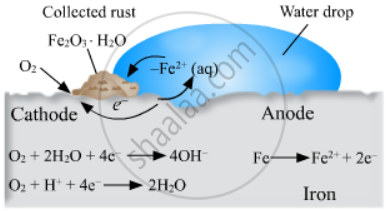
Observe the following picture a write down the chemical reaction with the explanation.
Write scientific reasons.
Lemon or tamarind is used for cleaning copper vessels turned greenish.
Answer the following question.
a) What is meant by corrosion?
b) Write names of any two methods of prevention of corrosion.
c) In which method, metal like copper, aluminium are coated with a thin layer of their oxides by means of electrolysis.
d) Explain this method with diagram.
Write three methods of preventing rusting of iron.
Rusting of iron : Fe2O3 : : corrosion of copper : ______
Find the correlation:
Bronze : ______ :: Tin : Cu+Zn.
Match the columns.
| Group A | Group B |
| 1) Electroplating | a) Pressure cooker |
| 2) Anodising | b) Silver plated spoons |
| c) Coating of tin on copper | |
| d) Coating of Zinc on iron |
Write scientific reason.
On exposure to air, silver articles turn blackish after some time.
Draw a neat labelled diagram.
Electrolysis
Observe the following diagram and write answers.
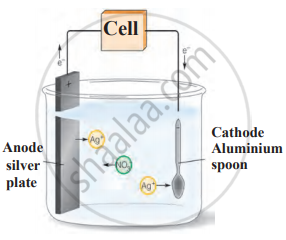
- Name the method.
- Explain the method.
- Give two examples of this method.
The table shown below gives information about four substances: A, B, C and D.
| SUBSTANCE | MELTING POINT (K) | ELECTRICAL CONDUCTIVITY | |
| SOLID | LIQUID/ AQUEOUS | ||
| A | 295 | Good | Good |
| B | 1210 | Poor | Good |
| C | 1890 | Poor | Good |
| D | 1160 | Poor | Poor |
Identify Ionic compounds from the above given substances.
Marble’s popularity began in ancient Rome and Greece, where white and off-white marble were used to construct a variety of structures, from hand-held sculptures to massive pillars and buildings.

The substance not likely to contain CaCO3 is:
