Advertisements
Advertisements
Question
Find the odd man out:
Options
Tinning
Anodization
Alloying
Froth floatation
Advertisements
Solution
Froth floatation
APPEARS IN
RELATED QUESTIONS
Which metals do not corrode easily?
What are alloys?
Which of the following methods is suitable for preventing an iron frying pan from rusting?
Give reasons:
Platinum, gold and silver are used to make jewellery.
What special name is given to the corrosion of iron?
Name any three objects (or structures) which are gradually damaged by the corrosion of iron and steel.
The corrosion of iron is called ______.
Why is an iron grill painted frequently?
What is the corrosion of iron known as?
Give the constituents of brass.
Name a common metal which is highly resistant to corrosion.
No chemical reaction takes place when granules of a rusty-brown solid A are mixed with the powder of another solid B. However, when the mixture is heated, a reaction takes place between its components. One of the products C is a metal and settles down in the molten state while the other product D floats over it. It was observed that the reaction is highly exothermic.
- What could the solids A and B be?
- What are the products C and D most likely to be?
- Write the chemical equation for the reaction between A and B leading to the formation of C and D. Mention the physical states of all the reactants and products in this equation and indicate the heat change which takes place.
- What is the special name of such a reaction? State one use of such a reaction.
- Name any two types of chemical reactions under which the above reaction can be classified.
Name the metal which is a constituent of plant pigment?
No chemical reaction takes place when granules of a solid, A, are mixed with the powder of another solid, B. However when the mixture is heated, a reaction takes place between its components. One of the products, C, is a metal and settles down in the molten state while the other product, D, floats over it. It was observed that the reaction is highly exothermic.
(i) Based on the given information make an assumption about A and B and write a chemical equation for the chemical reaction indicating the conditions of reaction, physical state of reactants and products and thermal status of reaction.
(ii) Mention any two types of reactions under which above chemical reaction can be classified.
What is done to prevent corrosion of metals?
Answer the following question:
What is corrosion? Do gold ornaments corrode? Justify.
Write three methods of preventing rusting of iron.
Answer the following question.
List two properties of alloys.
Give reason.
Copper and brass utensils should be tinned.
Explain the term – rusting and give a word equation for the formation of rust. If polished iron nails are kept in three separate test tubes, state the contents in each test tube required, to prove the conditions for rusting.
State whether the statement given below is true or false. If false write the correct statement.
Graphite is a lustrous non-metal which conducts electricity.
To prevent corrosion of iron and steel _______ method is used.
Pressure cooker : Anodizing : : Silver plated spoons : _______
Match the columns.
| Group A | Group B |
| 1) Electroplating | a) Pressure cooker |
| 2) Anodising | b) Silver plated spoons |
| c) Coating of tin on copper | |
| d) Coating of Zinc on iron |
Write scientific reason.
Anodization method is useful for prevention of the corrosion of the aluminium.
What is rust?
Observe the following diagram and give answers.
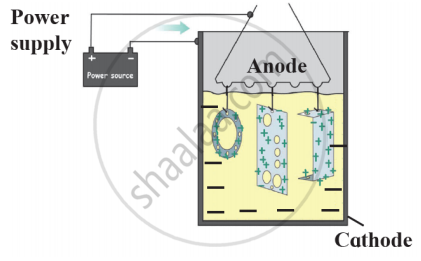
- Name this method of prevention of corrosion.
- For prevention of which metal this method is used?
- What is used as anode in this method?
Observe the following figure and write the answer of the question.
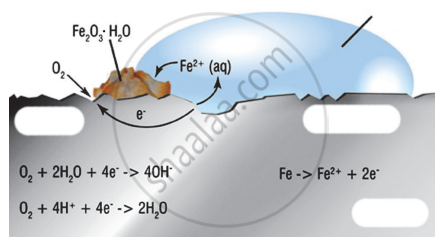
- Which process is shown in the figure?
- Explain the chemical reaction shown in the figure.
- Write the reactions on anode and cathode.
Give solutions by giving examples of corrosion?
What is rust?
Give the equation for the formation of rust.
Generally, when metals are treated with mineral acids, hydrogen gas is liberated but when metals (except Mn and Mg), treated with HNO3, hydrogen is not liberated, why?
A man painted his main gate made up of iron, to
- prevent it from rusting.
- protect it from sun.
- make it look beautiful.
- make it dust free.
Which of the above statement(s) is/are correct?
Give an example of a chemical reaction for the following situation:
Sound is produced
