No Chemical Reaction Takes Place When Granules of a Solid, A, Are Mixed with the Powder of Another Solid, B
Advertisements
Question
No chemical reaction takes place when granules of a solid, A, are mixed with the powder of another solid, B. However when the mixture is heated, a reaction takes place between its components. One of the products, C, is a metal and settles down in the molten state while the other product, D, floats over it. It was observed that the reaction is highly exothermic.
(i) Based on the given information make an assumption about A and B and write a chemical equation for the chemical reaction indicating the conditions of reaction, physical state of reactants and products and thermal status of reaction.
(ii) Mention any two types of reactions under which above chemical reaction can be classified.
Advertisements
Solution
(i) Solid A is assumed to be MnO2 and solid B to be Aluminium (Al).
When the mixture of MnO2 and Al is heated, manganese (Mn) is produced in molten state and aluminium oxide (Al2O3) floats over it. Mn is produced in the molten state as a lot of heat energy is released in the process.
The chemical equation for the reaction can be written as:
3MnO2(s) + 4Al(s) `triangle/`> 3Mn(f) + 2Al2O3(s) + Heat
(ii) The types of reaction under which the above reaction is classified are—
-
Redox reaction
-
Displacement reaction
APPEARS IN
RELATED QUESTIONS
Why do we apply paint on iron articles?
Choose the correct answer from the options given below:
Heating an ore in a limited supply of air or in the absence of air at a temperature just below its melting point is known as
A. Smelting
B. Ore-dressing
C. Calcination
D. Bessemerisation
Tiffin boxes are electroplated with ______ but car bumpers are electroplated with ______ to protect them from rusting.
Name five methods of preventing rusting of iron.
Brass is an alloy of ______.
No chemical reaction takes place when granules of a rusty-brown solid A are mixed with the powder of another solid B. However, when the mixture is heated, a reaction takes place between its components. One of the products C is a metal and settles down in the molten state while the other product D floats over it. It was observed that the reaction is highly exothermic.
- What could the solids A and B be?
- What are the products C and D most likely to be?
- Write the chemical equation for the reaction between A and B leading to the formation of C and D. Mention the physical states of all the reactants and products in this equation and indicate the heat change which takes place.
- What is the special name of such a reaction? State one use of such a reaction.
- Name any two types of chemical reactions under which the above reaction can be classified.
Mention two uses of the following metals and non-metals
Iron
Name the metal which is a constituent of blood pigment?
Observe the following picture a write down the chemical reaction with the explanation.
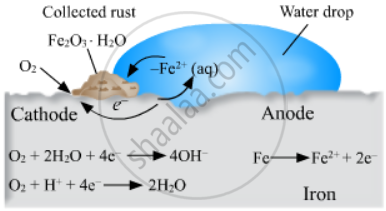
Answer the following question.
a) What is meant by corrosion?
b) Write names of any two methods of prevention of corrosion.
c) In which method, metal like copper, aluminium are coated with a thin layer of their oxides by means of electrolysis.
d) Explain this method with diagram.
Give reason.
A wooden article should be polished.
Observe the following diagram and give answers.
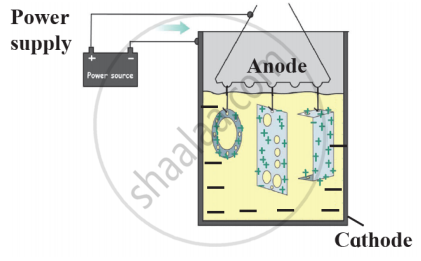
- Name this method of prevention of corrosion.
- For prevention of which metal this method is used?
- What is used as anode in this method?
Observe the following diagram and write answers.
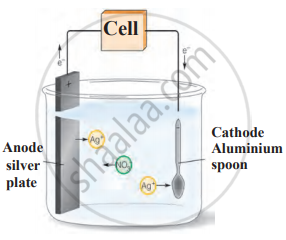
- Name the method.
- Explain the method.
- Give two examples of this method.
Copper objects lose their shine and form green coating of ____________.
Explain the following:
Lime water turns milky on passing carbon dioxide gas into it.
Explain the following:
Bubbles are produced when acetic acid is added to a solution of sodium hydrogencarbonate.
Give scientific reasons.
Silver amalgam is used for filling dental cavities.
Explain the chemical reactions in rusting of iron.
Describe two changes that are harmful. Explain why you consider them harmful. How can you prevent them?
