Advertisements
Advertisements
Question
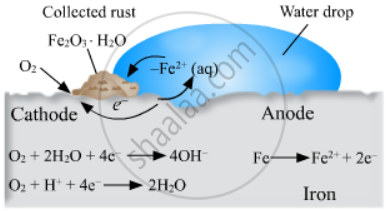
Observe the following picture a write down the chemical reaction with the explanation.
Advertisements
Solution
The rusting of iron is an oxidation process. The rust on iron does not form by a simple reaction between oxygen and iron surface. The rust is formed by an electrochemical reaction. 'Fe' oxidises to Fe2O3.XH2O (Rust) is on one part of the iron surface, while oxygen gets reduced to H2O in another part of the surface. Different regions on the surface of iron become anode and cathode.
(1) Fe is oxidised to Fe2+ in the anode region.
\[\ce{Fe(s) -> Fe^{2+}(aq) + 2e^-}\]
(2) O2 is reduced to form water in the cathode region.
\[\ce{O2(g) + 4H^+(aq) + 4e^- -> 2H2O(l)}\]
When Fe2+ ions migrate from the anode region, they react with water and further get oxidised to form Fe3+ ions.
A reddish-coloured hydrated oxide is formed from Fe3+ ions. It is called rust. It collects on the surface.
\[\ce{2Fe^{3+}(aq) + 4H2O(l) -> Fe2O3.H2O(s) + 6H^+(aq)}\]
Due to various components of the atmosphere, oxidation of metals takes place, consequently resulting in their damage. This is called 'corrosion'. Iron rusts, and a reddish-coloured layer is collected on it. This is the corrosion of iron.
RELATED QUESTIONS
Which metals do not corrode easily?
Two methods by which rusting of iron can be prevented are ______ and ______.
Explain why rusting of iron objects is faster in coastal areas than in deserts.
The chemical reaction involved in the corrosion of iron metal is that of ______.
What is meant by galvanisation? Why is it done?
In one method of rust prevention, the iron is not coated with anything. Which is this method?
The corrosion of iron is called ______.
The corrosion of copper produces a ______ coating of basic copper carbonate on its surface.
Give the constituents of brass.
Name two metals which resist corrosion due to the formation of a thin, hard and impervious layer of oxide on their surface.
Name an alloy of copper. State its chemical composition and any one use.
Name a common metal which is highly resistant to corrosion.
Four metals P, Q, R and S are all obtained by the reduction of their oxides with carbon. Metal P is used to form a thin layer over the sheets of metal S to prevent its corrosion. Metal Q is used for electroplating tiffin boxes made of metal S whereas metal R is used in making car batteries. Metals Q and R form an alloy called solder. What are metals P, Q, R and S? How have you arrived at this conclusion?
Name the metal which is a constituent of blood pigment?
Name the metal which is a constituent of plant pigment?
Corrosion can be an advantage in some case.Explain ?
Write scientific reasons.
Lemon or tamarind is used for cleaning copper vessels turned greenish.
Identify the process shown in the diagram and explain it in short

Answer the following question:
What is corrosion? Do gold ornaments corrode? Justify.
Give reason.
An iron article should be given a coat of paint
Give reason.
A wooden article should be polished.
Give reason for the following:
A suspension of rust is basic in nature.
Write a short note on Alloying.
Write scientific reason.
Anodization method is useful for prevention of the corrosion of the aluminium.
Write scientific reason.
Coins are made from metals and alloys.
Draw a neat labelled diagram.
Anodizing
Observe the following diagram and write answers.
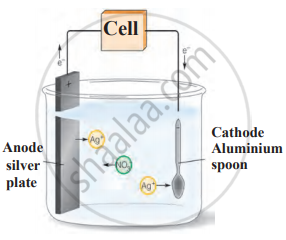
- Name the method.
- Explain the method.
- Give two examples of this method.
The process of coating the surface of the metal with a thin layer of zinc is called ______
What is rust?
Which among the following alloys contain mercury as one of its constituents?
Alloys are homogeneous mixtures of a metal with a metal or non-metal. Which among the following alloys contain non-metal as one of its constituents?
Galvanisation is a process used to prevent the rusting of which of the following?
Give an example of a chemical reaction for the following situation:
Sound is produced
Give scientific reasons.
Silver amalgam is used for filling dental cavities.
