Advertisements
Advertisements
Question
Give reason.
Copper and brass utensils should be tinned.
Advertisements
Solution
Copper and brass materials also undergo corrosion, resulting in the formation of a greenish layer on this surface. When the surface of copper or brass is contacted by air or water, it results in corrosion, and to prevent this, the process of tining is used. In this process, copper and brass articles are coated with tin.
RELATED QUESTIONS
What is an alloy?
What type of chemical reaction is involved in the corrosion of iron?
Name the metal which is used for galvanising iron.
A common metal which is highly resistant to corrosion is ______.
No chemical reaction takes place when granules of a solid, A, are mixed with the powder of another solid, B. However when the mixture is heated, a reaction takes place between its components. One of the products, C, is a metal and settles down in the molten state while the other product, D, floats over it. It was observed that the reaction is highly exothermic.
(i) Based on the given information make an assumption about A and B and write a chemical equation for the chemical reaction indicating the conditions of reaction, physical state of reactants and products and thermal status of reaction.
(ii) Mention any two types of reactions under which above chemical reaction can be classified.
Find the odd man out:
What is done to prevent corrosion of metals?
Rusting of iron : Fe2O3 : : corrosion of copper : ______
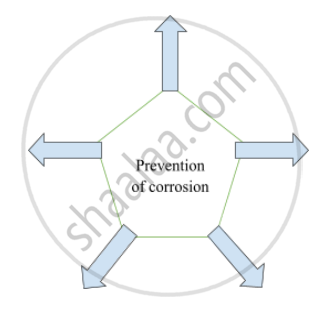
Complete flow chart given below.
State whether the following statement is true or false:
Ships suffer a lot of damage though they are painted.
