Advertisements
Advertisements
Question
Write a molecular formula for rust.
Advertisements
Solution
The chemical formula of rust is Fe2O3•xH2O.
RELATED QUESTIONS
What are alloys?
Two methods by which rusting of iron can be prevented are ______ and ______.
What special name is given to the corrosion of iron?
What is meant by galvanisation? Why is it done?
Explain why, iron sheets are coated with zinc.
The process of depositing a thin layer of zinc on iron articles is called ______.
______ and ______ are necessary for the rusting of iron.
What is corrosion?
Name any two metals which do not corrode easily.
With the help of labelled diagrams, describe an activity to find out the conditions under which iron rusts.
Name five methods of preventing rusting of iron.
Name the metal which is a constituent of blood pigment?
Explain how the activity series accounts for each of the following:
tendency to corrosion
Corrosion can be an advantage in some case.Explain ?
No chemical reaction takes place when granules of a solid, A, are mixed with the powder of another solid, B. However when the mixture is heated, a reaction takes place between its components. One of the products, C, is a metal and settles down in the molten state while the other product, D, floats over it. It was observed that the reaction is highly exothermic.
(i) Based on the given information make an assumption about A and B and write a chemical equation for the chemical reaction indicating the conditions of reaction, physical state of reactants and products and thermal status of reaction.
(ii) Mention any two types of reactions under which above chemical reaction can be classified.
Observe the following picture a write down the chemical reaction with the explanation.
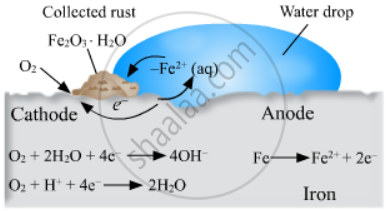
Write scientific reasons.
Lemon or tamarind is used for cleaning copper vessels turned greenish.
Answer the following question.
a) What is meant by corrosion?
b) Write names of any two methods of prevention of corrosion.
c) In which method, metal like copper, aluminium are coated with a thin layer of their oxides by means of electrolysis.
d) Explain this method with diagram.
Find the odd man out:
Answer the following question:
What is corrosion? Do gold ornaments corrode? Justify.
Write three methods of preventing rusting of iron.
Give reason.
An iron article should be given a coat of paint
Write a short note on Alloying.
Observe the following picture and answer the following questions:
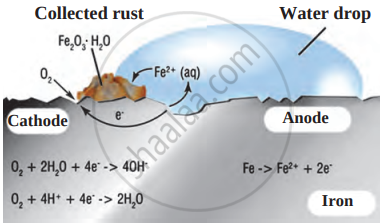
- What is rust?
- Write the chemical formula of rust.
- Write the reaction of oxidation of iron at the anode.
- Write the reaction of oxidation of iron at the cathode.
- What is corrosion?
When one of the metals in an alloy is mercury the alloy is called _______.
Rusting of iron : Fe2O3 : : corrosion of copper : ______
Find the odd one out and give its explanation.
Write the name.
Method used to present corrosion of copper.
Observe the following diagram and write answers.
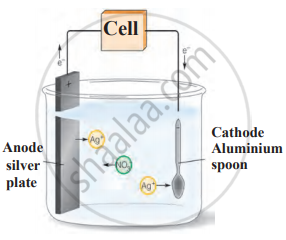
- Name the method.
- Explain the method.
- Give two examples of this method.
The process of coating the surface of the metal with a thin layer of zinc is called ______
Amalgam is an alloy of ____________.
Copper objects lose their shine and form green coating of ____________.
The diagram shows the reaction between metal and dil. acid.

What is the reason for different behaviour of Mg in test tube B?
The table shown below gives information about four substances: A, B, C and D.
| SUBSTANCE | MELTING POINT (K) | ELECTRICAL CONDUCTIVITY | |
| SOLID | LIQUID/ AQUEOUS | ||
| A | 295 | Good | Good |
| B | 1210 | Poor | Good |
| C | 1890 | Poor | Good |
| D | 1160 | Poor | Poor |
Identify Ionic compounds from the above given substances.
Marble’s popularity began in ancient Rome and Greece, where white and off-white marble were used to construct a variety of structures, from hand-held sculptures to massive pillars and buildings.

The substance not likely to contain CaCO3 is:
Explain the following:
Lime water turns milky on passing carbon dioxide gas into it.
Give an example of a chemical reaction for the following situation:
Sound is produced
