Advertisements
Advertisements
Question
Bronze : _______ : : Stainless steel : Fe + Cr + C
Advertisements
Solution
Bronze : Cu + Sn : : Stainless steel : Fe + Cr + C
APPEARS IN
RELATED QUESTIONS
Write two methods of preventing the rusting of iron.
Explain the term corrosion.
What are alloys?
Two methods by which rusting of iron can be prevented are ______ and ______.
Explain why rusting of iron objects is faster in coastal areas than in deserts.
Explain why Iron sheets are coated with zinc during galvanization.
Choose the correct answer from the options given below:
Heating an ore in a limited supply of air or in the absence of air at a temperature just below its melting point is known as
A. Smelting
B. Ore-dressing
C. Calcination
D. Bessemerisation
What is the corrosion of iron known as?
Give the constituents of brass.
What are the constituents of stainless steel?
Name an alloy of copper. State its chemical composition and any one use.
Name a common metal which is highly resistant to corrosion.
A metal X which is resistant to corrosion is produced by the electrolysis of its molten oxide whereas another metal Y which is also resistant to corrosion is produced by the reduction of its oxide with carbon. Metal X can be used in powder form in thermite welding whereas metal Y is used in making cathodes of ordinary dry cells.
- Name the metals X and Y.
- Which of the two metals is more reactive: X or Y?
- Name one ore or metal X. Also write its chemical formula.
- Name one ore of metal Y. Also write its chemical formula.
- Name one alloy of metal X and one alloy of metal Y.
Four metals P, Q, R and S are all obtained by the reduction of their oxides with carbon. Metal P is used to form a thin layer over the sheets of metal S to prevent its corrosion. Metal Q is used for electroplating tiffin boxes made of metal S whereas metal R is used in making car batteries. Metals Q and R form an alloy called solder. What are metals P, Q, R and S? How have you arrived at this conclusion?
Name the metal which is a constituent of plant pigment?
Explain how the activity series accounts for each of the following:
tendency to corrosion
What is corrosion? What are necessary conditions for corrosion?
Find the odd man out:
Answer the following question:
What is corrosion? Do gold ornaments corrode? Justify.
State whether the statement given below is true or false. If false write the correct statement.
Graphite is a lustrous non-metal which conducts electricity.
Corrosion of silver causes a black layer of _______.
To prevent corrosion of iron and steel _______ method is used.
Find the odd one out and give its explanation.
Write the name.
An alloy of copper and tin-
Write scientific reason.
Coins are made from metals and alloys.
Draw a neat labelled diagram.
Anodizing
Observe the following diagram and give answers.
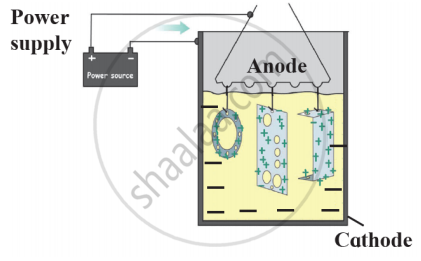
- Name this method of prevention of corrosion.
- For prevention of which metal this method is used?
- What is used as anode in this method?
Observe the following figure and write the answer of the question.
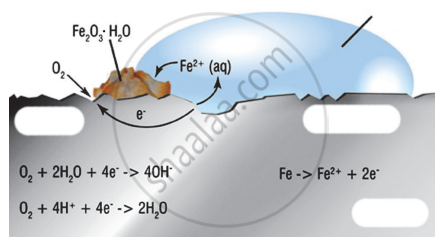
- Which process is shown in the figure?
- Explain the chemical reaction shown in the figure.
- Write the reactions on anode and cathode.
The process of coating the surface of the metal with a thin layer of zinc is called ______
What is rust?
Galvanisation is a method of protecting iron from rusting by coating it with a thin layer of ____________.
The table shown below gives information about four substances: A, B, C and D.
| SUBSTANCE | MELTING POINT (K) | ELECTRICAL CONDUCTIVITY | |
| SOLID | LIQUID/ AQUEOUS | ||
| A | 295 | Good | Good |
| B | 1210 | Poor | Good |
| C | 1890 | Poor | Good |
| D | 1160 | Poor | Poor |
Identify Ionic compounds from the above given substances.
Marble’s popularity began in ancient Rome and Greece, where white and off-white marble were used to construct a variety of structures, from hand-held sculptures to massive pillars and buildings.

The substance not likely to contain CaCO3 is:
Iron pillar near the Qutub Minar in Delhi is famous for the following facts. Which of these facts is responsible for its long stability?
Give scientific reasons.
Silver amalgam is used for filling dental cavities.
In ______ process a layer of molten tin is deposited on metals.
