Advertisements
Advertisements
प्रश्न
Compare roasting and calcination.
Distinguish between:
Roasting - Calcination
Advertisements
उत्तर
| Roasting | Calcination | |
| 1. | This method is generally used for sulphide ores | This method is generally used for carbonate ores. |
| 2. | In this method, ores are heated in excess of air. | In this method, ores are heated in a limited supply of air. |
| 3. | In roasting, generally sulphur dioxide gas is evolved. | In calcination, generally carbon dioxide gas is evolved. |
| 4. | In this method, sulphide ores are oxidized to form metal oxides. E.g. \[\ce{2ZnS + 3O2 -> 2ZnO + 2SO2 \uparrow}\] |
In this method, carbonate ores decompose to form metal oxide. E.g. \[\ce{ZnCO3 -> ZnO + CO2 \uparrow}\] |
APPEARS IN
संबंधित प्रश्न
What is an alloy?
Give two examples of alloys with their chemical composition.
Tinning : Tin : : Galvanizing : _________
Which metals do not corrode easily?
What are alloys?
Explain why rusting of iron objects is faster in coastal areas than in deserts.
What special name is given to the corrosion of iron?
Why is an iron grill painted frequently?
Explain why, though aluminium is more reactive than iron, yet there is less corrosion of aluminium when both are exposed to air.
Name any two metals which do not corrode easily.
Name two metals which resist corrosion due to the formation of a thin, hard and impervious layer of oxide on their surface.
Explain why, when a copper object remains in damp air for a considerable time, a green coating is formed on its surface. What is this process known as?
In stainless steel alloy, iron metal is mixed with ______.
Brass is an alloy of ______.
No chemical reaction takes place when granules of a rusty-brown solid A are mixed with the powder of another solid B. However, when the mixture is heated, a reaction takes place between its components. One of the products C is a metal and settles down in the molten state while the other product D floats over it. It was observed that the reaction is highly exothermic.
- What could the solids A and B be?
- What are the products C and D most likely to be?
- Write the chemical equation for the reaction between A and B leading to the formation of C and D. Mention the physical states of all the reactants and products in this equation and indicate the heat change which takes place.
- What is the special name of such a reaction? State one use of such a reaction.
- Name any two types of chemical reactions under which the above reaction can be classified.
A metal X which is resistant to corrosion is produced by the electrolysis of its molten oxide whereas another metal Y which is also resistant to corrosion is produced by the reduction of its oxide with carbon. Metal X can be used in powder form in thermite welding whereas metal Y is used in making cathodes of ordinary dry cells.
- Name the metals X and Y.
- Which of the two metals is more reactive: X or Y?
- Name one ore or metal X. Also write its chemical formula.
- Name one ore of metal Y. Also write its chemical formula.
- Name one alloy of metal X and one alloy of metal Y.
Bronze is an alloy of ______.
Explain how the activity series accounts for each of the following:
tendency to corrosion
No chemical reaction takes place when granules of a solid, A, are mixed with the powder of another solid, B. However when the mixture is heated, a reaction takes place between its components. One of the products, C, is a metal and settles down in the molten state while the other product, D, floats over it. It was observed that the reaction is highly exothermic.
(i) Based on the given information make an assumption about A and B and write a chemical equation for the chemical reaction indicating the conditions of reaction, physical state of reactants and products and thermal status of reaction.
(ii) Mention any two types of reactions under which above chemical reaction can be classified.
Observe the following picture a write down the chemical reaction with the explanation.
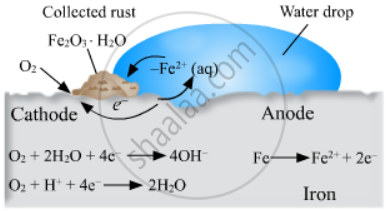
What is ‘rusting’?
Answer the following question.
List two properties of alloys.
Write a short note on Alloying.
To prevent corrosion of iron and steel _______ method is used.
Pressure cooker : Anodizing : : Silver plated spoons : _______
Rusting of iron : Fe2O3 : : corrosion of copper : ______
Write scientific reason.
Coins are made from metals and alloys.
Observe the following diagram and write answers.
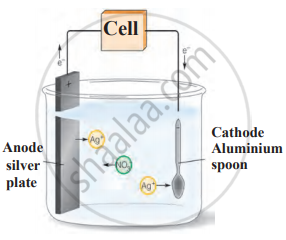
- Name the method.
- Explain the method.
- Give two examples of this method.
Copper objects lose their shine and form green coating of ____________.
Which among the following alloys contain mercury as one of its constituents?
Alloys are homogeneous mixtures of a metal with a metal or non-metal. Which among the following alloys contain non-metal as one of its constituents?
Iron pillar near the Qutub Minar in Delhi is famous for the following facts. Which of these facts is responsible for its long stability?
Explain the following:
Lime water turns milky on passing carbon dioxide gas into it.
Explain the chemical reactions in rusting of iron.
Describe two changes that are harmful. Explain why you consider them harmful. How can you prevent them?
