Advertisements
Advertisements
प्रश्न
Distinguish between:
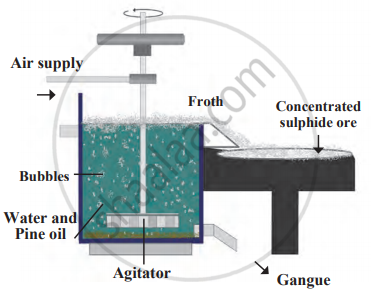
Froth floatation - Leaching
Advertisements
उत्तर
| Froth floatation | Leaching | |
| 1. | The froth floatation method is based on the two opposite properties, hydrophilic and hydrophobic, of the gangue and ore particles respectively. | Leaching method is based on the dissolution of ore particles in a certain solution. |
| 2. | There is no chemical reaction involved. | There is a specific chemical reaction between ore and the solution used for leaching. |
| 3. | This method involves the formation of froth from oil, water, and air bubbles together, due to the agitation. | There is no formation of froth. |
| 4. | This method is used for concentration of zinc blende and copper pyrite. | This method is used for the concentration of bauxite. |
संबंधित प्रश्न
Give the importance of the following for living beings:
Carbon
brown powder deposit on iron?
Metal A has an electronic configuration of 2, 8, 1 and metal B has 2, 8, 8, 2 which is a more reactive metal.
Give the effect of heat on their: nitrates
A student has been collecting silver coins and copper coins. One day she observed a black
coating on silver coins and a green coating on copper coins. Which chemical phenomenon is
responsible for these coatings? Write the names of black and green coatings.
What do you observe when hydrogen is passed over heated copper oxide?
`Ag2O` ................................
`2Pb(NO3)_2` .........................
Where are the cathode and anode in the electrolytic cell? Name the material used for these?
Arrange the metals in (2) in the decreasing order of reactivity.
Aluminium is extracted from its chief ore, bauxite. The ore is first purified and then the metal is extracted from it by electrolytic reduction.
Write three balanced equations for the purification of bauxite.
Why does iron or zinc not occur free in nature?
Right or wrong sentence.
Cassiterite is a copper metal.
Write scientific reason.
Magnetic separation method is used to separate the magnetic ingredients in the ores.
Draw a neat and labelled diagram for Froth Floatation Process.
Observe the figure and name and explain in brief the following method:
Explain the smelting process.
Which of the following methods is used to separate wolframite and stannic oxide present in cassiterite?
After partial roasting, the sulphide of copper is reduced by ______.
Calcination is used in metallurgy for the removal of?
