Advertisements
Advertisements
Question
Distinguish between:
Froth floatation - Leaching
Advertisements
Solution
| Froth floatation | Leaching | |
| 1. | The froth floatation method is based on the two opposite properties, hydrophilic and hydrophobic, of the gangue and ore particles respectively. | Leaching method is based on the dissolution of ore particles in a certain solution. |
| 2. | There is no chemical reaction involved. | There is a specific chemical reaction between ore and the solution used for leaching. |
| 3. | This method involves the formation of froth from oil, water, and air bubbles together, due to the agitation. | There is no formation of froth. |
| 4. | This method is used for concentration of zinc blende and copper pyrite. | This method is used for the concentration of bauxite. |
RELATED QUESTIONS
Metal A has an electronic configuration of 2, 8, 1 and metal B has 2, 8, 8, 2 which is a more reactive metal.
Give the effect of heat on their: carbonates
Name:
(a) the processes involved in
concentration :-
An ore on being heated in air forms sulphurous anhydride. Write the process used for the concentration of this ore.
With a labelled diagram, explain the electro-refining of a particular metal.
Give the ionization reactions of electrolyte used in Hall’s process. write the reaction at the cathode and the anode. Why the anode has to be replaced in this process?
state the reactions at the two electrodes ?
Which metal is used for:
lithographic plates for printing
State two properties of brass that render it more useful for some purpose than its components.
What is magnalium? Name the main elements present in it? Write its one use ?
A compound that is added to lower the fusion temperature of the electrolytic bath in the extraction of aluminium.
The following is a sketch of an electrolytic cell used in the extraction of aluminium :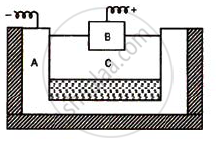
(a) What is the substance of which the electrode A and B are made?
(b) At which electrode (A or B) is aluminium formed?
(c) What are the two aluminium compounds in the electrolyte C?
(d) Why is it necessary for electrode B to be continuously replaced?
What do you observe when hydrogen is passed over heated copper oxide?
The chemical formula of zinc blend is _______.
Zirconium is refined by ____________.
Which of the following methods is used to separate wolframite and stannic oxide present in cassiterite?
Which of following metals occurs in native state?
After partial roasting, the sulphide of copper is reduced by ______.
