Advertisements
Advertisements
प्रश्न
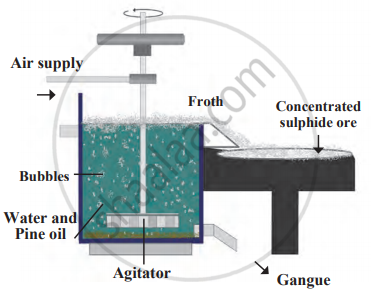
Observe the figure and name and explain in brief the following method:
Advertisements
उत्तर
The method shown in the figure is froth floatation method.
- The froth floatation process is based on two opposite properties of the particles, hydrophilic and hydrophobic.
- The metal sulphide particles are hydrophobic. Due to this property, they get wetted mainly with oil. On the other hand, gangue particles are hydrophilic and get wetted by water.
- In this method, the finely divided metal ore is added in a big tank containing a large amount of water. To this, certain vegetable oil (pine oil, eucalyptus oil, etc.) is added is added for the formation of froth. A rotating agitator at the centre of the floatation tank agitates the mixture and draws air into it to form bubbles. As a result, foam is formed which carries metal sulphide particles. The foam rises to the surface of water and floats. Therefore, this method is called the froth floatation process.
- This method is used to separate metal sulphide ores such as zinc blende (ZnS) and copper pyrite (CuFeS2).
APPEARS IN
संबंधित प्रश्न
Give the importance of the following for living beings:
Nitrogen
Give the importance of the following for living beings:
Hydrogen
Define the term ‘metallurgy’. State the processes involved in metallurgy ?
Name:
(b) two metallic oxides which cannot be reduced by carbon, carbon monoxide or hydrogen
Explain the following terms:
(a) flux
Explain the following terms:
(c) slag
`MnO_2 + 4Al`  …………….
`2Pb(NO3)_2` .........................
Why is flux used in the blast furnace?
Which metal is used for:
lithographic plates for printing
Why does iron or zinc not occur free in nature?
Write the molecular formulae of the following compound.
Ferrous tungstate
Explain concept with example/explain with the help of a balanced equation.
Gangue
Identify the following method of concentration of ores and explain briefly.
Explain the froth floatation method with a neat labelled diagram.
State the reason for the addition of caustic alkali to bauxite ore during the purification of bauxite.
Bassemerisation is used in the extraction of ______.
In leaching of alumina from bauxite by Bayer's process, then ore is treated with ______.
After partial roasting, the sulphide of copper is reduced by ______.
Identify false statement regarding lithium aluminium hydride?
