Advertisements
Advertisements
प्रश्न
Study the following principle and answer the question.
A force is excreted on the current carrying conductor. The direction of this force depends on both the direction of the current and the direction of the magnetic field. This force is maximum when the direction of current is perpendicular to the direction of the magnetic field.
a) By which law we can determine the direction of force excreted on the current carrying conductor.
b) In which electrical equipment this principle is used.
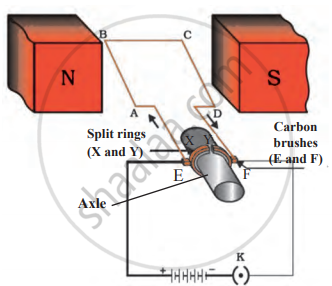
c) Draw a diagram representing construction of this equipment.
d) Write the working of this equipment in brief.
Advertisements
उत्तर
a. Fleming’s left hand rule
b. Electric motor

d. completed, the current flows through the coil in the direction A-B-C-D.
ii. The coil is in the magnetic field therefor according to Fleming’s left hand rule force exerted on the AB branch is in downward direction and on the CD branch it is in upward direction.
iii. After half rotation current in the coil start flowing through D-C-B-A direction.
iv. therefore, on DC branch force is in downward direction and BA branch it is in upward direction so its complete remaining half rotation.
In this way after every half rotation the direction of the current in the coil changes and coil continue to rotate.
APPEARS IN
संबंधित प्रश्न
What is the Principle of an Electric motor?
Name any four appliances where electric motor is used.
What is the role of the split ring in an electric motor?
State whether the following statement is true or false.
An electric motor converts mechanical energy into electrical energy.
Name some devices in which electric motors are used
Explain the function of the following parts of an electric motor.
Armature
Explain the function of the following parts of an electric motor.
Brushes
Explain the function of the following parts of an electric motor.
Split ring
Label the four parts of an electric motor

State whether the following statement is true or false:
An electric motor converts mechanical energy into electrical energy.
Name the device which is used to reverse the direction of current in the coil of a motor?
What is the other name of the split ring used in an electric motor?
Of what substance is the core of the coil of an electric motor made?
In an electric motor, which of the following remains fixed and which rotates with the coil?
Commutator ; Brush
Fill in the following blank with suitable words:
Fleming's Rule for the motor effect uses the .......... hand.
What is the principle of an electric motor?
What are the special features of commercial electric motors?
In an electric motor, the direction of current in the coil changes once in each:
two rotations
one rotation
half rotation
one-four rotation
Which device is used to produce electricity? Describe with a neat diagram.
Right or wrong sentence.
Electro chemicals are devices that convert electrical energy into mechanical energy.
Observe the figure and write the answers to the questions asked.
- The construction shown in the figure is of which device?
- Explain the principle on which this device works.
- Write any three uses of this device.
Which of the following converts electrical energy into mechanical energy?
An electric motor converts ______.
List the main parts of an electric motor.
An electric motor is a device which transforms ____________.
Direction of rotation of a coil in electric motor is determined by ____________.
In an electric motor, to make the coil rotating continuously in the same direction, the current is reversed in the coil after every half rotation by a device called ____________.
Commercial electric motors do not use ____________.
Material of the core of a strong magnet is ____________.
Draw a labelled circuit diagram of a simple electric motor and explain its working. In what way these simple electric motors are different from commercial motors?
Draw an appropriate schematic diagram showing common domestic circuits and discuss the importance of fuse. Why is it that a burnt out fuse should be replaced by another fuse of identical rating?
The most suitable material for making permanent magnets is ______.
