Advertisements
Advertisements
प्रश्न
Study the following principle and answer the question.
A force is excreted on the current carrying conductor. The direction of this force depends on both the direction of the current and the direction of the magnetic field. This force is maximum when the direction of current is perpendicular to the direction of the magnetic field.
a) By which law we can determine the direction of force excreted on the current carrying conductor.
b) In which electrical equipment this principle is used.
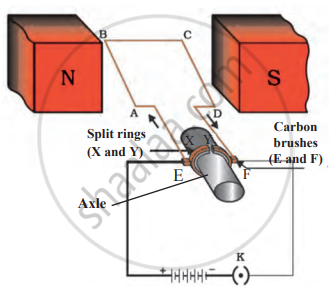
c) Draw a diagram representing construction of this equipment.
d) Write the working of this equipment in brief.
Advertisements
उत्तर
a. Fleming’s left hand rule
b. Electric motor

d. completed, the current flows through the coil in the direction A-B-C-D.
ii. The coil is in the magnetic field therefor according to Fleming’s left hand rule force exerted on the AB branch is in downward direction and on the CD branch it is in upward direction.
iii. After half rotation current in the coil start flowing through D-C-B-A direction.
iv. therefore, on DC branch force is in downward direction and BA branch it is in upward direction so its complete remaining half rotation.
In this way after every half rotation the direction of the current in the coil changes and coil continue to rotate.
APPEARS IN
संबंधित प्रश्न
What is the Principle of an Electric motor?
Name any four appliances where electric motor is used.
What is the role of the split ring in an electric motor?
State whether the following statement is true or false.
An electric motor converts mechanical energy into electrical energy.
Explain the construction and working of an electric motor.
Explain the function of the following parts of an electric motor.
Split ring
Electric motor works on the magnetic effect of electric current.
State whether the following statement is true or false:
An electric motor converts mechanical energy into electrical energy.
Name the device which is used to reverse the direction of current in the coil of a motor?
What is the function of a commutator in an electric motor made ?
What is the role of the spilt ring in an electric motor?
Fill in the following blank with suitable words:
A motor contains a kind of switch called a .......... which reverses the current every half .......... .
In a d.c. motor, why must the current to the coil be reversed twice during each rotation?
State what would happen to the direction of rotation of a motor if:
the current were reversed
State what would happen to the direction of rotation of a motor if:
both current and magnetic field were reversed simultaneously.
What is an electric motor? With the help of a labelled diagram, describe the working of a simple electric motor
What are the special features of commercial electric motors?
In an electric motor, the direction of current in the coil changes once in each:
two rotations
one rotation
half rotation
one-four rotation
An electric motor is a device which transforms:
mechanical energy to electrical
heat energy to electrical energy
electrical energy to heat energy only
electrical energy to mechanical energy
Draw a labelled diagram of an electric motor.
Electric motor : converts electrical energy into mechanical energy : : Electric generator : _______
Observe the figure and write the answers to the questions asked.
- The construction shown in the figure is of which device?
- Explain the principle on which this device works.
- Write any three uses of this device.
Which of the following converts electrical energy into mechanical energy?
An electric motor converts ______.
State whether true or false. If false, correct the statement.
A generator converts mechanical energy into electrical energy.
Commercial electric motors do not use ____________.
Draw a labelled circuit diagram of a simple electric motor and explain its working. In what way these simple electric motors are different from commercial motors?
How can the speed of rotation of a coil be increased? Write at least three methods.
The moving part of an electric motor is called ______.
Observe the following diagram and answer the questions.

- Construction of which equipment does the above diagram show?
- On which principle does this equipment work?
- According to which law the coil ABCD rotates?
- Write the law in your own words.
- Where is this equipment used?
