Advertisements
Advertisements
प्रश्न
Four metals P, Q, R and S are all obtained by the reduction of their oxides with carbon. Metal P is used to form a thin layer over the sheets of metal S to prevent its corrosion. Metal Q is used for electroplating tiffin boxes made of metal S whereas metal R is used in making car batteries. Metals Q and R form an alloy called solder. What are metals P, Q, R and S? How have you arrived at this conclusion?
Advertisements
उत्तर
Metal P is Zn (zinc), Q is Sn (tin), R is Pb (lead) and S is Fe (iron).
We arrive to the following conclusion:
Metal P (zinc) is used to form a thin layer on metal S (iron). The process of thin coating of zinc layer on iron objects is called galvanisation. This thin coating of zinc layer on iron objects protects it from corrosion (zinc is a highly reactive metal. It does not rust even in moisture because it forms a thin coat of zinc oxide on reacting with air).
Metal Q (tin) is used for electroplating tiffin boxes made of metal S (iron). This tin coating prevents the corrosion of iron. However, tin coating provides only outside protection.
Metal R (lead) is used in making car batteries. Metal Q (tin) and metal R (lead) are combined together to form an alloy called solder.
APPEARS IN
संबंधित प्रश्न
Explain the term corrosion.
What are alloys?
What type of chemical reaction is involved in the corrosion of iron?
What is meant by galvanisation? Why is it done?
Name two metals which resist corrosion due to the formation of a thin, hard and impervious layer of oxide on their surface.
If copper is kept exposed to damp air for a considerable time, it gets a green coating on its surface. This is due to the formation of:
(a) hydrated copper sulphate
(b) copper oxide
(c) basic copper carbonate
(d) copper nitrate
Brass is an alloy of:
(a) Cu and Sn
(b) Cu and Pb
(c) Pb and Sn
(d) Zn and Cu
Explain how the activity series accounts for each of the following:
tendency to corrosion
Explain with reason:
Roasting is carried out on sulphide ores and not on carbonate ores.
Observe the following picture a write down the chemical reaction with the explanation.
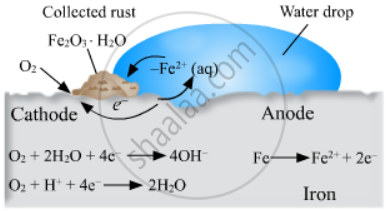
Complete the process of iron rusting by filling the blanks. Suggest a way to prohibit the process.
The iron rust is formed due to........................... reaction. Different
regions on iron surface become anode and cathode.
Reaction on anode region :
`F_e(s) → Fe^(2+) (aq) +2e^-`
Reaction on anode region :
`O_2(g) + 4H^+(aq) +............................ → 2H_2 O (l) `
When Fe2+ ions migrate from anode region they react with ................... to form Fe3+ ions.
A reddish coloured hydrated oxide is formed from ............... ions. It is called rust.
`2Fe_(3+) (aq) + 4H_2O(l) → ................. + 6H_+(aq) `
A way to prevent rusting ..................................................................
What is done to prevent corrosion of metals?
Give reason.
Copper and brass utensils should be tinned.
Pressure cooker : Anodizing : : Silver plated spoons : _______
Write the name.
Method used to prevent corrosion of copper.
Explain concept with example/explain with the help of a balanced equation.
Corrosion
Draw a neat labelled diagram.
Anodizing
The diagram shows the reaction between metal and dil. acid.

What is the reason for different behaviour of Mg in test tube B?
Explain the following:
Lime water turns milky on passing carbon dioxide gas into it.
