Advertisements
Advertisements
प्रश्न
Four metals P, Q, R and S are all obtained by the reduction of their oxides with carbon. Metal P is used to form a thin layer over the sheets of metal S to prevent its corrosion. Metal Q is used for electroplating tiffin boxes made of metal S whereas metal R is used in making car batteries. Metals Q and R form an alloy called solder. What are metals P, Q, R and S? How have you arrived at this conclusion?
Advertisements
उत्तर
Metal P is Zn (zinc), Q is Sn (tin), R is Pb (lead) and S is Fe (iron).
We arrive to the following conclusion:
Metal P (zinc) is used to form a thin layer on metal S (iron). The process of thin coating of zinc layer on iron objects is called galvanisation. This thin coating of zinc layer on iron objects protects it from corrosion (zinc is a highly reactive metal. It does not rust even in moisture because it forms a thin coat of zinc oxide on reacting with air).
Metal Q (tin) is used for electroplating tiffin boxes made of metal S (iron). This tin coating prevents the corrosion of iron. However, tin coating provides only outside protection.
Metal R (lead) is used in making car batteries. Metal Q (tin) and metal R (lead) are combined together to form an alloy called solder.
APPEARS IN
संबंधित प्रश्न
Explain the term corrosion.
Give reasons:
Platinum, gold and silver are used to make jewellery.
Explain why Iron sheets are coated with zinc during galvanization.
The chemical reaction involved in the corrosion of iron metal is that of ______.
In stainless steel alloy, iron metal is mixed with:
(a) Cu and Cr
(b) Cr and Ni
(c) Cr and Sn
(d) Cu and Ni
A metal X which is resistant to corrosion is produced by the electrolysis of its molten oxide whereas another metal Y which is also resistant to corrosion is produced by the reduction of its oxide with carbon. Metal X can be used in powder form in thermite welding whereas metal Y is used in making cathodes of ordinary dry cells.
(a) Name the metals X and Y.
(b) Which of the two metals is more reactive : X or Y?
(c) Name one ore or metal X. Also write its chemical formula.
(d) Name one ore or metal Y. Also write its chemical formula.
(e) Name one alloy of metal X and one alloy of metal Y.
Name the metal which is a constituent of blood pigment?
Corrosion can be an advantage in some case.Explain ?
Give reason.
An iron article should be given a coat of paint
Give reason.
A wooden article should be polished.
Give reason.
Copper and brass utensils should be tinned.
Observe the following picture and answer the following questions:
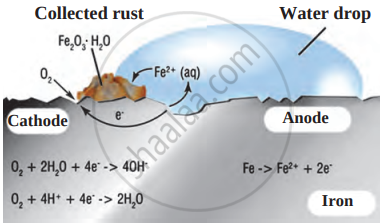
- What is rust?
- Write the chemical formula of rust.
- Write the reaction of oxidation of iron at the anode.
- Write the reaction of oxidation of iron at the cathode.
- What is corrosion?
Bronze : _______ : : Stainless steel : Fe + Cr + C
Find the odd one out and give its explanation.
Write the name.
An alloy of copper and tin-
Draw a neat labelled diagram.
Electroplating
Observe the following figure and write the answer of the question.
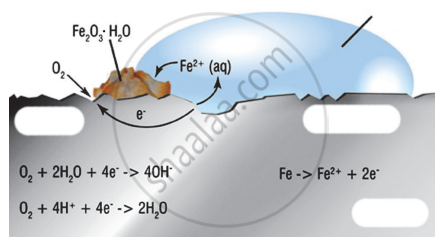
- Which process is shown in the figure?
- Explain the chemical reaction shown in the figure.
- Write the reactions on anode and cathode.
What is rust?
Explain the following:
Lime water turns milky on passing carbon dioxide gas into it.
Describe two changes that are harmful. Explain why you consider them harmful. How can you prevent them?
