Advertisements
Advertisements
प्रश्न
The chemical reaction involved in the corrosion of iron metal is that of ______.
विकल्प
oxidation as well as displacement
reduction as well as combination
oxidation as well as combination
reduction as well as displacement
Advertisements
उत्तर
The chemical reaction involved in the corrosion of iron metal is that of oxidation as well as combination.
Explanation:
During corrosion, iron metal reacts with oxygen gas in the presence of moisture to form hydrated iron(III) oxide (rust). This is an oxidation reaction because oxygen is added to the iron. It is also a combination reaction because multiple reactants (iron, oxygen, and water) fuse together to form a single compound.
APPEARS IN
संबंधित प्रश्न
Explain the term corrosion.
Give reasons:
Platinum, gold and silver are used to make jewellery.
Explain why rusting of iron objects is faster in coastal areas than in deserts.
Choose the correct answer from the options given below:
Heating an ore in a limited supply of air or in the absence of air at a temperature just below its melting point is known as
A. Smelting
B. Ore-dressing
C. Calcination
D. Bessemerisation
The corrosion of copper produces a ______ coating of basic copper carbonate on its surface.
What are the special properties of stainless steel?
Name a common metal which is highly resistant to corrosion.
If copper is kept exposed to damp air for a considerable time, it gets a green coating on its surface. This is due to the formation of ______.
A metal X which is resistant to corrosion is produced by the electrolysis of its molten oxide whereas another metal Y which is also resistant to corrosion is produced by the reduction of its oxide with carbon. Metal X can be used in powder form in thermite welding whereas metal Y is used in making cathodes of ordinary dry cells.
- Name the metals X and Y.
- Which of the two metals is more reactive: X or Y?
- Name one ore or metal X. Also write its chemical formula.
- Name one ore of metal Y. Also write its chemical formula.
- Name one alloy of metal X and one alloy of metal Y.
Find the odd man out:
Explain the term – rusting and give a word equation for the formation of rust. If polished iron nails are kept in three separate test tubes, state the contents in each test tube required, to prove the conditions for rusting.
_______ forms a green colour in the water.
Write scientific reason.
Coins are made from metals and alloys.
Observe the following diagram and give answers.
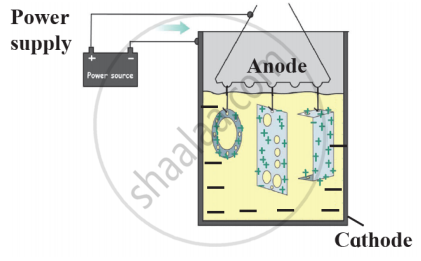
- Name this method of prevention of corrosion.
- For prevention of which metal this method is used?
- What is used as anode in this method?
Observe the following diagram and write answers.
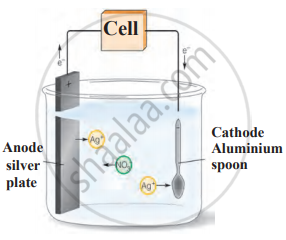
- Name the method.
- Explain the method.
- Give two examples of this method.
Galvanisation is a method of protecting iron from rusting by coating it with a thin layer of ____________.
Identify the correct statement from the following:
Generally, when metals are treated with mineral acids, hydrogen gas is liberated but when metals (except Mn and Mg), treated with HNO3, hydrogen is not liberated, why?
Explain the following:
Bubbles are produced when acetic acid is added to a solution of sodium hydrogencarbonate.
| A process of forming a thick oxide of aluminium when aluminium is exposed to air. This coat makes it resistant to corrosion. Resistance can be improved by making a layer of oxide thinker. In this technique, the aluminium article is the anode, and the electrolyte is sulphuric acid. The anode reaction results in the formation of a black-coloured film of aluminium oxide on the anode. By putting appropriate dyes in the electrolytic solution, both coloured surface with the decorative finish is achieved. Kitchen articles like anodised such as pressure cookers, pans and frames of sliding windows are applications of this technique. |
- Name the anode and electrolyte used in this technique.
- How can we make aluminium articles made resistant to corrosion?
- Name the technique used to coat the aluminium articles.
