Advertisements
Advertisements
प्रश्न
A common metal which is highly resistant to corrosion is ______.
विकल्प
iron
copper
aluminium
magnesium
Advertisements
उत्तर
A common metal which is highly resistant to corrosion is aluminium.
Explanation:
Aluminium is highly resistant to corrosion because it reacts rapidly with oxygen in the air to form a thin, tough, protective layer of aluminium oxide on its surface. This invisible oxide layer adheres tightly to the metal and prevents further oxygen or moisture from reacting with the fresh aluminium beneath.
APPEARS IN
संबंधित प्रश्न
Write two methods of preventing the rusting of iron.
Why do we apply paint on iron articles?
What are alloys?
Explain why rusting of iron objects is faster in coastal areas than in deserts.
Tiffin boxes are electroplated with ______ but car bumpers are electroplated with ______ to protect them from rusting.
Explain why, though aluminium is more reactive than iron, yet there is less corrosion of aluminium when both are exposed to air.
Name a common metal which is highly resistant to corrosion.
A metal X which is resistant to corrosion is produced by the electrolysis of its molten oxide whereas another metal Y which is also resistant to corrosion is produced by the reduction of its oxide with carbon. Metal X can be used in powder form in thermite welding whereas metal Y is used in making cathodes of ordinary dry cells.
- Name the metals X and Y.
- Which of the two metals is more reactive: X or Y?
- Name one ore or metal X. Also write its chemical formula.
- Name one ore of metal Y. Also write its chemical formula.
- Name one alloy of metal X and one alloy of metal Y.
Complete the process of iron rusting by filling the blanks. Suggest a way to prohibit the process.
The iron rust is formed due to........................... reaction. Different
regions on iron surface become anode and cathode.
Reaction on anode region :
`F_e(s) → Fe^(2+) (aq) +2e^-`
Reaction on anode region :
`O_2(g) + 4H^+(aq) +............................ → 2H_2 O (l) `
When Fe2+ ions migrate from anode region they react with ................... to form Fe3+ ions.
A reddish coloured hydrated oxide is formed from ............... ions. It is called rust.
`2Fe_(3+) (aq) + 4H_2O(l) → ................. + 6H_+(aq) `
A way to prevent rusting ..................................................................
Answer the following question.
a) What is meant by corrosion?
b) Write names of any two methods of prevention of corrosion.
c) In which method, metal like copper, aluminium are coated with a thin layer of their oxides by means of electrolysis.
d) Explain this method with diagram.
Answer the following question:
What is corrosion? Do gold ornaments corrode? Justify.
Answer the following question.
List two properties of alloys.
State whether the statement given below is true or false. If false write the correct statement.
Either oxygen or moisture is essential for rusting.
Write a short note on Alloying.
_______ is an alloy made from iron, carbon and chromium.
Observe the following figure and write the answer of the question.
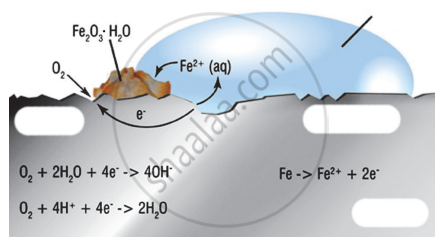
- Which process is shown in the figure?
- Explain the chemical reaction shown in the figure.
- Write the reactions on anode and cathode.
Identify the correct statement from the following:
Iron pillar near the Qutub Minar in Delhi is famous for the following facts. Which of these facts is responsible for its long stability?
Explain the following:
Lime water turns milky on passing carbon dioxide gas into it.
Gold plated ornaments is the example of ______.
