Advertisements
Advertisements
प्रश्न
Alkenes  and carbonyl compounds
  , both contain a π bond but alkenes show electrophilic addition reactions whereas carbonyl compounds show nucleophilic addition reactions. Explain.
Advertisements
उत्तर
Carbonyl group is polar in nature. Due to larger electronegativity of oxygen as compared to carbon, carbon acquires partial positive charge while O acquires partial negative charge.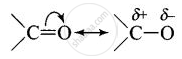
Because of slight positive charge on C atom, it is attacked by nucleophiles and, therefore, undergoes nucleophilic addition reaction.
Ethylenic double bond is a non-polar bond and is a source of electrons. Therefore, it is attacked by electrophiles and undergoes electrophilic addition reactions.
APPEARS IN
संबंधित प्रश्न
Write the products formed when CH3CHO reacts with the following reagents : H2N – OH
Predict the product of the following reaction:

What is meant by the following term? Give an example of the reaction in the following case.
Acetal
How will you bring about the following conversion in not more than two steps?
Bromobenzene to 1-Phenylethanol
Give plausible explanation for the following:
There are two −NH2 groups in semicarbazide. However, only one is involved in the formation of semicarbazones.
Write balanced chemical equations for action of ammonia on - acetaldehyde
Give a simple chemical test to distinguish between 
How will you convert benzoic acid to m-bromobenzoic acid?
Write a test to differentiate between pentan-2-one and pentan-3-one.
Grignard reagent on reaction with acetone forms.
The most stable reagent for the conversion of R – CH2OH → RCHO is
What is the action of sodium hypoiodite on acetone?
Which will undergo faster nucleophilic addition reaction?
Acetaldehyde or Propanone
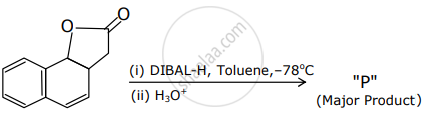
The product "P" in the above reaction is:
The product of following reaction is
\[\ce{CH3 - CH = CH - CH2 - CHO ->[i) LiAlH4][ii) H3O+]}\] ______?
Out of p-tolualdehyde and p-nitrobenzaldehyde, which one is more reactive towards nucleophilic addition reactions, why?
Write the structure of the product formed when acetone reacts with 2, 4 DNP reagent.
Draw structures of the given derivatives.
The ethylene ketal of hexan-3-one
Draw structure of the following derivative.
The ethylene ketal of hexane-3-one
Complete the following reaction:
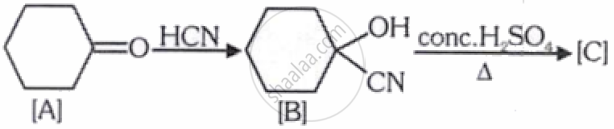
[C] is __________.
