Advertisements
Advertisements
प्रश्न
What is the action of the following reagents on ethanoic acid?
1) `LiAlH_4"/"H_3O^+`
2) `PCl_3 , "heat"`
3) `P_2O_5, "heat"`
Advertisements
उत्तर
1) \[\ce{\underset{\text{ethanoic acid}}{CH3} - COOH ->[LiAIH4IH3O+] \underset{\text{ethanol}}{CH3} -CH2-OH}\]
Ethanoic acid when treated with reducing agent like LiAlH4 , it gives ethanol
2) \[\ce{\underset{\text{ethanoic acid}}{3CH3 - COOH} - PCI3 ->[\Delta] \underset{\text{acetylcholoride}}{3CH3COCI + H3PO3}}\]
Ethanoic acid, when treated with PCl3, gives acetyl chloride
3) \[\ce{\underset{\text{two molecules of ethanoic acid}}{CH3COOH + CH3COOH} ⇌[P2O5][A] \underset{\text{acetic anhydride}}{(CH3 - CO)2O} + OH}\]
When two molecules of ethanoic acid heated with strong dehydrating agent P2O5, it removes water molecules to for acetic anhydride.
APPEARS IN
संबंधित प्रश्न
Arrange the following in the increasing order of their reactivity towards nucleophilic addition reaction:
C6H5COCH3, CH3-CHO, CH3COCH3
Arrange the following compound in increasing order of its reactivity in nucleophilic addition reactions.
Ethanal, Propanal, Propanone, Butanone.
Hint: Consider steric effect and electronic effect.
Predict the product of the following reaction:

What is meant by the following term? Give an example of the reaction in the following case.
Ketal
Predict the products formed when cyclohexanecarbaldehyde reacts with the following reagents.
Semicarbazide and weak acid
Predict the products formed when cyclohexanecarbaldehyde reacts with the following reagents.
Excess ethanol and acid
How will you bring about the following conversion in not more than two steps?
Bromobenzene to 1-Phenylethanol
Give plausible explanation for the following:
There are two −NH2 groups in semicarbazide. However, only one is involved in the formation of semicarbazones.
How are the following compounds prepared?
benzaldehyde from benzoyl chloride
Write balanced chemical equations for action of ammonia on - acetone
Write the structure of Phenylmethanamine.
What are amines?
Give a simple chemical test to distinguish between 
Write the main product formed when propanal reacts with the following reagents:
H2N- NH2 followed by heating with KOH in ethylene glycol.
How will you convert benzoic acid to m-bromobenzoic acid?
Which of the following is the correct representation for intermediate of nucleophilic addition reaction to the given carbonyl compound (A):
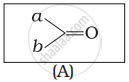
(i) 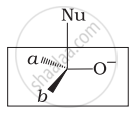
(ii) 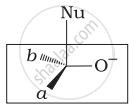
(iii) 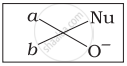
(iv) 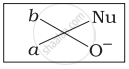
Write a test to differentiate between pentan-2-one and pentan-3-one.
Grignard reagent on reaction with acetone forms.
The most stable reagent for the conversion of R – CH2OH → RCHO is
Which among the following is most reactive to give nucleophilic addition?
The increasing order of the following compounds towards HCN addition is:
| (i) |  |
| (ii) |  |
| (iii) |  |
| (iv) |  |
Write the structure of the product formed when acetone reacts with 2, 4 DNP reagent.
Draw structures of the given derivatives.
The ethylene ketal of hexan-3-one
Draw the structure of the following derivative.
Acetaldehydedimethylacetal
Draw the structure of the given derivative.
The ethylene ketal of hexan-3-one
Give an example of the reaction in the following case.
Imine
Which of the following will not be formed when calcium formate is distilled with calcium acetate?
