Advertisements
Advertisements
प्रश्न
Explain the mechanism of alkaline hydrolysis of tert-butyl bromide with energy profile diagram.
Advertisements
उत्तर
Mechanism of Alkaline hydrolysis of tert-alkyl halide.
Consider the action of aqueous sodium hydroxide or potassium hydroxide on a tertiary alkyl halide such as t-butyl bromide.
\[\ce{(CH3)3 CBr + KOH}\] \[\ce{(CH3)3 COH + KBr}\]
The ionic form of the reaction is:
\[\ce{(CH3)3 CBr + :\bar{O}H}\] \[\ce{(CH3)3 COH + Br^-}\]
During this hydrolysis the stronger nucleophile, :OH–
has displaced the weaker nucleophile, Br– and therefore, it is nucleophilic substitution (SN) reaction.
Kineties of reaction: Experimentally is observed that the rate of the reaction depends only on the concentration of (CH3)3CBr and is independent of the concentration of the OH– ions, i.e.,
Rate = k [(CH3)3CBr]
Therefore, this reaction is first order nucleophilic substitution reaction SN1 reaction.
Mechanism: This nuclephilic substitution takes place in two steps which can be represented as follows.
Step (i): Ionization of t-butyl bromide:

The three methyl groups of tert-butyl bromide sterically hinder the approach of the nucleophile and thus prevent the backside attack. Therefore in the first step C–Br bond ionizes to give t-butyl carbocation and bromide ion.
Due to gradual breaking of the bond a transition state (T.S)1 is formed. The electron repelling inductive effect of the methyl groups facilitates the ionization, by stabilising, carbocation.
Step (ii): Attack of nucleophile `( :barO H)`

The nucleophile `( : barO H)` attacks the carbocation forming t-butyl alcohol. But due to gradual formation of the C–OH bond a transition state (T.S)2 is first formed. The carbocation has planar configuration, hence it can be attacked by the nucleophile from either side. The frontside attack results in the product with retention of configuration. However, the backside attack results in the product with inversion of configuration. Since the attack from either side is equally probable, there will be retention in 50% of the molecules and inversion in the 50% of the molecules.
Energy profile diagram is obtained by plotting the potential energies of all the species against the reaction co-ordinates. The two-humps in the graph indicates two steps in the reaction.
Activation energy is the energy which must be supplied to reactants in order to form the transition state. It is equal to difference in potential energies of reactants and the transition state. The step-(i) has a higher activation energy, hence it is slow. The step-(ii) has lower activation energy, hence it is fast.

Ea1 = Energy of activation for step 1
Ea2 = Energy of activation for step 2
?H = Heat of reaction.
In multi-step reactions the slowest step determines the overall rate of reaction. This is called the rate controlling step. In the slow step only t-butyl bormide takes part and not the nucleophile. Hence it is a first order reaction.
APPEARS IN
संबंधित प्रश्न
Arrange the following in the increasing order of their reactivity towards nucleophilic addition reaction:
C6H5COCH3, CH3-CHO, CH3COCH3
Write the structures of the main products when acetone (CH3 − CO − CH3) reacts with the following reagent :
H2N − NHCONH2/H+
Write the products formed when CH3CHO reacts with the following reagents : HCN
Arrange the following compound in increasing order of its reactivity in nucleophilic addition reactions.
Ethanal, Propanal, Propanone, Butanone.
Hint: Consider steric effect and electronic effect.
Arrange the following compound in increasing order of its reactivity in nucleophilic addition reactions.
Benzaldehyde, p-Tolualdehyde, p-Nitrobenzaldehyde, Acetophenone.
Hint: Consider steric effect and electronic effect.
Predict the product of the following reaction:

What is meant by the following term? Give an example of the reaction in the following case.
Imine
What is meant by the following term? Give an example of the reaction in the following case.
2, 4-DNP-derivative
Predict the products formed when cyclohexanecarbaldehyde reacts with the following reagents.
PhMgBr and then H3O+
Write balanced chemical equations for action of ammonia on - acetone
What are amines?
Give a simple chemical test to distinguish between 
Write the main product formed when propanal reacts with the following reagents:
2 moles of 3 CH OH in presence of dry HCl
Acetone, Acetaldehyde, Benzaldehyde, Acetophenone – reactivity towards addition of HCN.
Carboxylic acids contain carbonyl group but do not show the nucleophilic addition reaction like aldehydes or ketones. Why?
Acetaldehyde and acetone differ in their reaction with
The most stable reagent for the conversion of R – CH2OH → RCHO is
Arrange the following in the increasing order of their property indicated:
Ethanal, Propanone, Propanal, Butanone (reactivity towards nucleophilic addition)
What happens when propanone is treated with CH3MgBr and then hydrolysed?
The increasing order of the following compounds towards HCN addition is:
| (i) |  |
| (ii) |  |
| (iii) |  |
| (iv) |  |
Which of the following is most reactive in nucleophilic addition reactions?
The following questions are case-based questions. Read the passage carefully and answer the questions that follow:
| The carbon-oxygen double bond is polarised in aldehydes and ketones due to higher electronegativity of oxygen relative to carbon. Therefore, they undergo nucleophilic addition reactions with a number of nucleophiles such as HCN, NaHSO3, alcohols, ammonia derivatives and Grignard reagents. Aldehydes are easily oxidised by mild oxidising agents as compared to ketones. The carbonyl group of carboxylic acid does not give reactions of aldehydes and ketones. Carboxylic acids are considerably more acidic than alcohols and most of simple phenols. |
Answer the following:
(a) Write the name of the product when an aldehyde reacts with excess alcohol in the presence of dry HCl. (1)
(b) Why carboxylic acid is a stronger acid than phenol? (1)
(c) (i) Arrange the following compounds in increasing order of their reactivity towards CH3MgBr: (1)
CH3CHO, \[\begin{array}{cc}
\ce{(CH3)3C-C-CH3}\\
\phantom{....}||\\
\phantom{....}\ce{O}
\end{array}\], \[\begin{array}{cc}
\ce{CH3-C-CH3}\\
||\\
\ce{O}
\end{array}\]
(ii) Write a chemical test to distinguish between propanal and propanone. (1)
OR
(c) Write the main product in the following: (2)
| (i) | 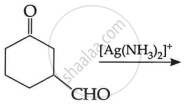 |
| (ii) |  |
Draw structures of the given derivatives.
The ethylene ketal of hexan-3-one
Draw structure of the following derivative.
Acetaldehydedimethylacetal
Draw structure of the following derivative.
The ethylene ketal of hexan-3-one
Give an example of the reaction in the following case.
Oxime
The major product of the following reaction is:
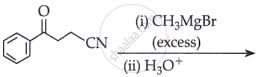
Complete the following reaction:
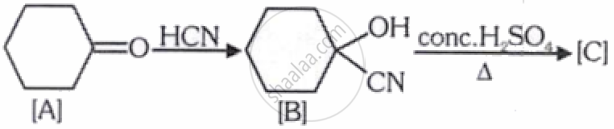
[C] is __________.
