Advertisements
Advertisements
प्रश्न
Arrange the following compound in increasing order of its reactivity in nucleophilic addition reactions.
Benzaldehyde, p-Tolualdehyde, p-Nitrobenzaldehyde, Acetophenone.
Hint: Consider steric effect and electronic effect.
Advertisements
उत्तर
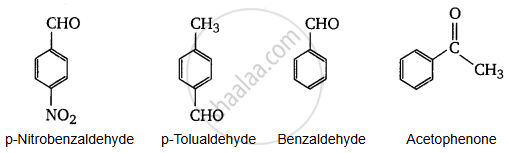
- The +I effect is more in ketones than in aldehydes. Hence, acetophenone is the least reactive in nucleophilic addition reactions.
- Among aldehydes, the +I effect is the highest in p-tolualdehyde because of the presence of the electron-donating −CH3 group and the lowest in p-nitrobezaldehyde because of the presence of the electron-withdrawing −NO2 group.
- Hence, the increasing order of the reactivities of the given compounds is:
Acetophenone < p-Tolualdehyde < Benzaldehyde < p-Nitrobenzaldehyde
APPEARS IN
संबंधित प्रश्न
Arrange the following in the increasing order of their reactivity towards nucleophilic addition reaction:
C6H5COCH3, CH3-CHO, CH3COCH3
Write the structures of the main products when acetone (CH3 − CO − CH3) reacts with the following reagent :
H2N − NHCONH2/H+
What is meant by the following term? Give an example of the reaction in the following case.
Cyanohydrin
What is meant by the following term? Give an example of the reaction in the following case.
Hemiacetal
Predict the products formed when cyclohexanecarbaldehyde reacts with the following reagents.
PhMgBr and then H3O+
Complete the synthesis by giving missing starting material, reagent or product.
\[\ce{C6H5CHO ->[H2NCONHNH2]}\]
Give a simple chemical test to distinguish between 
Carboxylic acids contain carbonyl group but do not show the nucleophilic addition reaction like aldehydes or ketones. Why?
The pH of blood does not appreciably change by a small addition of acid or base because
Acetaldehyde and acetone differ in their reaction with
The most stable reagent for the conversion of R – CH2OH → RCHO is
What happens when propanone is treated with CH3MgBr and then hydrolysed?
The product of following reaction is
\[\ce{CH3 - CH = CH - CH2 - CHO ->[i) LiAlH4][ii) H3O+]}\] ______?
Why dissociation of HCN is suppressed by the addition of HCL?
The product of the following reaction is
\[\begin{array}{cc}
\ce{O}\phantom{.........}\\
||\phantom{.........}\\
\ce{C2H5 - C - CH3 ->[H2/Ni][\Delta] \phantom{..}?}\end{array}\]
Draw the structure of the following derivative.
Acetaldehydedimethylacetal
Draw structure of the following derivative:
Acetaldehydedimethylacetal
Draw structures of the following derivatives.
Acetaldehydedimethylacetal
