Advertisements
Advertisements
Question
Arrange the following compound in increasing order of its reactivity in nucleophilic addition reactions.
Benzaldehyde, p-Tolualdehyde, p-Nitrobenzaldehyde, Acetophenone.
Hint: Consider steric effect and electronic effect.
Advertisements
Solution
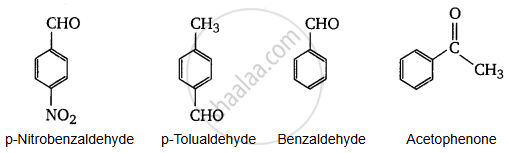
- The +I effect is more in ketones than in aldehydes. Hence, acetophenone is the least reactive in nucleophilic addition reactions.
- Among aldehydes, the +I effect is the highest in p-tolualdehyde because of the presence of the electron-donating −CH3 group and the lowest in p-nitrobezaldehyde because of the presence of the electron-withdrawing −NO2 group.
- Hence, the increasing order of the reactivities of the given compounds is:
Acetophenone < p-Tolualdehyde < Benzaldehyde < p-Nitrobenzaldehyde
APPEARS IN
RELATED QUESTIONS
Draw the structure of the semicarbazone of ethanal.
Write the products formed when CH3CHO reacts with the following reagents : HCN
Arrange the following compound in increasing order of its reactivity in nucleophilic addition reactions.
Ethanal, Propanal, Propanone, Butanone.
Hint: Consider steric effect and electronic effect.
What is meant by the following term? Give an example of the reaction in the following case.
2, 4-DNP-derivative
What is meant by the following term? Give an example of the reaction in the following case.
Schiff’s base
Complete the synthesis by giving missing starting material, reagent or product.
\[\ce{C6H5CHO ->[H2NCONHNH2]}\]
Complete the synthesis by giving missing starting material, reagent or product.

How are the following compounds prepared?
acetophenone from benzene
How are the following compounds prepared?
benzaldehyde from benzoyl chloride
Write balanced chemical equations for action of ammonia on - acetone
Write the main product formed when propanal reacts with the following reagents:
2 moles of 3 CH OH in presence of dry HCl
Write the main product formed when propanal reacts with the following reagents:
H2N- NH2 followed by heating with KOH in ethylene glycol.
How will you convert benzoic acid to m-bromobenzoic acid?
Reaction of aqueous sodium hydroxide on chlorobenzene gives which of the following products?
The most stable reagent for the conversion of R – CH2OH → RCHO is
What happens when propanone is treated with CH3MgBr and then hydrolysed?
Draw structure of the following derivative.
The ethylene ketal of hexan-3-one
Draw structures of the given derivatives.
The ethylene ketal of hexan-3-one
