Advertisements
Advertisements
Question
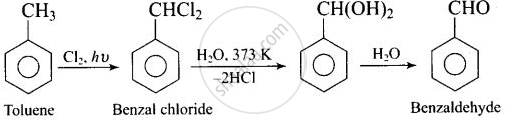
Benzaldehyde can be obtained from benzal chloride. Write reactions for obtaining benzalchloride and then benzaldehyde from it.
Advertisements
Solution
APPEARS IN
RELATED QUESTIONS
Write balanced chemical equations for action of ammonia on - formaldehyde
Arrange the following in the increasing order of their reactivity towards nucleophilic addition reaction:
C6H5COCH3, CH3-CHO, CH3COCH3
Predict the product of the following reaction:

What is meant by the following term? Give an example of the reaction in the following case.
Imine
Predict the products formed when cyclohexanecarbaldehyde reacts with the following reagents.
PhMgBr and then H3O+
Predict the products formed when cyclohexanecarbaldehyde reacts with the following reagents.
Excess ethanol and acid
Give plausible explanation for the following:
There are two −NH2 groups in semicarbazide. However, only one is involved in the formation of semicarbazones.
Complete the synthesis by giving missing starting material, reagent or product.

Reaction of aqueous sodium hydroxide on chlorobenzene gives which of the following products?
Which one of the following gives only one monochloro derivative?
Grignard reagent on reaction with acetone forms.
The most stable reagent for the conversion of R – CH2OH → RCHO is
Write the name of product formed, when acetone is treated with 2, 4-dinitrophenyl hydrazine.
In the following reaction
\[\ce{Carbonyl compound + MeOH <=>[HCl] acetal}\]
Rate of the reaction is the highest for ______.
Aldehydes and ketones react with hydroxylamine to form ______.
Write the structure of the product formed when acetone reacts with 2, 4 DNP reagent.
Draw the structure of the following derivative.
The ethylene ketal of hexane-3-one
Draw structure of the following derivative.
The ethylene ketal of hexan-3-one
Draw structures of the following derivatives.
Acetaldehydedimethylacetal
Draw the structure of the given derivative.
The ethylene ketal of hexan-3-one
