Advertisements
Advertisements
Question
What is meant by the following term? Give an example of the reaction in the following case.
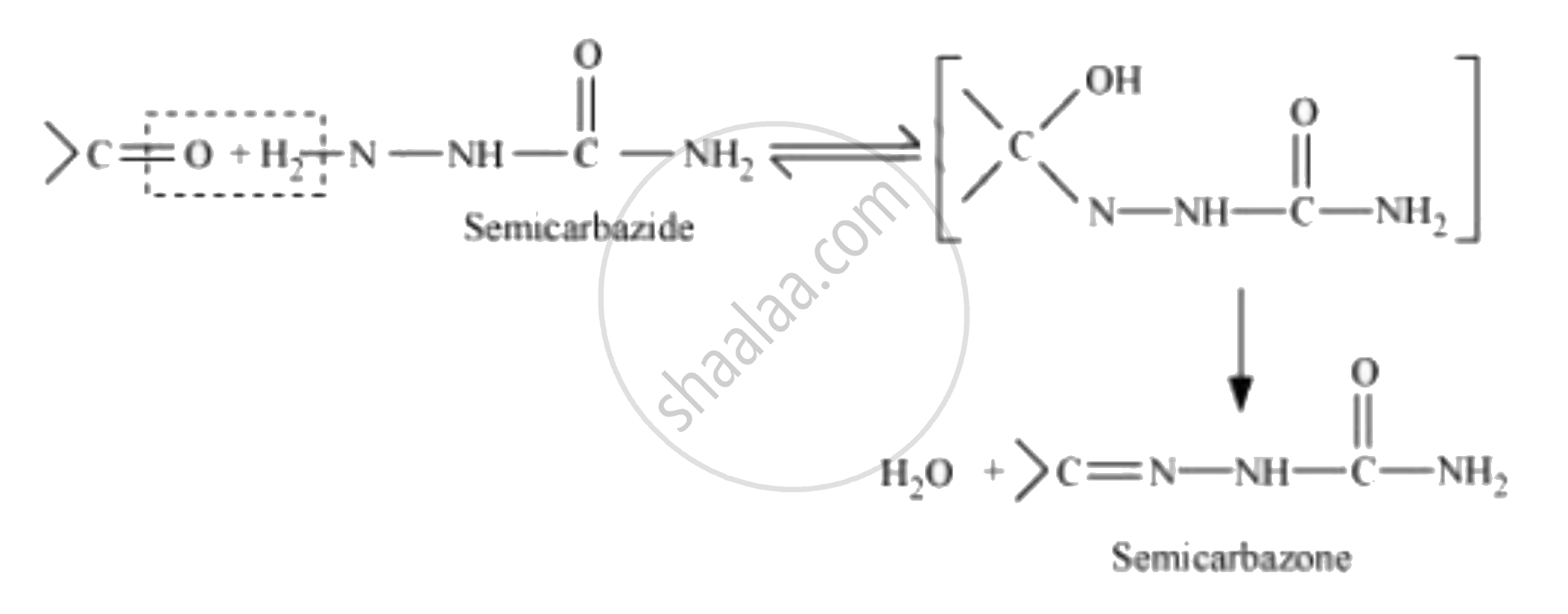
Semicarbazone
Advertisements
Solution
Semicarbazones are derivatives of aldehydes and ketones produced by the condensation reaction between a ketone or aldehyde and semicarbazide.
APPEARS IN
RELATED QUESTIONS
Write the products formed when CH3CHO reacts with the following reagents : HCN
What is meant by the following term? Give an example of the reaction in the following case.
Schiff’s base
Predict the products formed when cyclohexanecarbaldehyde reacts with the following reagents.
PhMgBr and then H3O+
Predict the products formed when cyclohexanecarbaldehyde reacts with the following reagents.
Semicarbazide and weak acid
How will you bring about the following conversion in not more than two steps?
Bromobenzene to 1-Phenylethanol
Complete the synthesis by giving missing starting material, reagent or product.

Explain the mechanism of alkaline hydrolysis of tert-butyl bromide with energy profile diagram.
Write balanced chemical equations for action of ammonia on - acetone
What are amines?
Give a simple chemical test to distinguish between 
Write a test to differentiate between pentan-2-one and pentan-3-one.
Alkenes  and carbonyl compounds
  , both contain a π bond but alkenes show electrophilic addition reactions whereas carbonyl compounds show nucleophilic addition reactions. Explain.
The pH of blood does not appreciably change by a small addition of acid or base because
What is the action of sodium hypoiodite on acetone?
Aldehydes and ketones react with hydroxylamine to form ______.
Draw structures of the given derivatives.
The ethylene ketal of hexan-3-one
Draw structures of the following derivative.
The ethylene ketal of hexan-3-one
Draw structures of the following derivatives.
Acetaldehydedimethylacetal
Draw structure of the following derivative.
The ethylene ketal of hexan-3-one
