Advertisements
Advertisements
प्रश्न
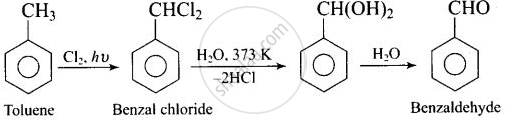
Benzaldehyde can be obtained from benzal chloride. Write reactions for obtaining benzalchloride and then benzaldehyde from it.
Advertisements
उत्तर
APPEARS IN
संबंधित प्रश्न
Arrange the following in the increasing order of their reactivity towards nucleophilic addition reaction:
C6H5COCH3, CH3-CHO, CH3COCH3
Write the structures of the main products when acetone (CH3 − CO − CH3) reacts with the following reagent :
H2N − NHCONH2/H+
What is meant by the following term? Give an example of the reaction in the following case.
Acetal
What is meant by the following term? Give an example of the reaction in the following case.
Oxime
What is meant by the following term? Give an example of the reaction in the following case.
Ketal
How will you bring about the following conversion in not more than two steps?
Bromobenzene to 1-Phenylethanol
Give plausible explanation for the following:
There are two −NH2 groups in semicarbazide. However, only one is involved in the formation of semicarbazones.
How are the following compounds prepared?
acetophenone from benzene
How are the following compounds prepared?
benzaldehyde from benzoyl chloride
Write the main product formed when propanal reacts with the following reagents:
2 moles of 3 CH OH in presence of dry HCl
Write a test to differentiate between pentan-2-one and pentan-3-one.
Which one of the following gives only one monochloro derivative?
What is the action of sodium hypoiodite on acetone?
Which of the following is most reactive in nucleophilic addition reactions?
Out of p-tolualdehyde and p-nitrobenzaldehyde, which one is more reactive towards nucleophilic addition reactions, why?
Draw structures of the given derivatives.
The ethylene ketal of hexan-3-one
The product of the following reaction is
\[\begin{array}{cc}
\ce{O}\phantom{.........}\\
||\phantom{.........}\\
\ce{C2H5 - C - CH3 ->[H2/Ni][\Delta] \phantom{..}?}\end{array}\]
Draw structure of the following derivative.
The ethylene ketal of hexan-3-one
Draw structures of the following derivatives.
Acetaldehydedimethylacetal
Complete the following reaction:
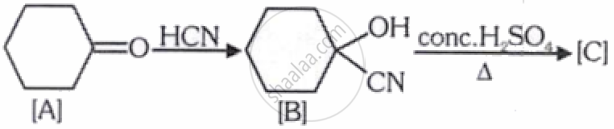
[C] is __________.
