Advertisements
Advertisements
प्रश्न
Arrange the following in the increasing order of their reactivity towards nucleophilic addition reaction:
C6H5COCH3, CH3-CHO, CH3COCH3
Advertisements
उत्तर
Aldehydes are generally more reactive than ketones in nucleophilic addition reactions because of steric and electronic reasons. In case of ketones, aromatic ketones are more susceptible to nucleophilic attack than aliphatic ketones.
CH3COCH3 < C6H5COCH3 < CH3CHO
APPEARS IN
संबंधित प्रश्न
Predict the products of the following reactions:

Give plausible explanation for the following:
Cyclohexanone forms cyanohydrin in good yield but 2, 2, 6 trimethylcyclohexanone does not.
What is the action of the following reagents on ethanoic acid?
1) `LiAlH_4"/"H_3O^+`
2) `PCl_3 , "heat"`
3) `P_2O_5, "heat"`
Which one of the following gives only one monochloro derivative?
Which among the following is most reactive to give nucleophilic addition?
Arrange the following in the increasing order of their property indicated:
Ethanal, Propanone, Propanal, Butanone (reactivity towards nucleophilic addition)
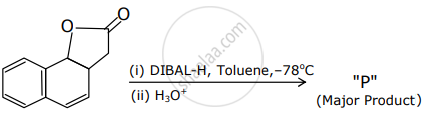
The product "P" in the above reaction is:
In the following reaction
\[\ce{Carbonyl compound + MeOH <=>[HCl] acetal}\]
Rate of the reaction is the highest for ______.
Write the structure of the product formed when acetone reacts with 2, 4 DNP reagent.
Draw structures of the following derivatives.
Acetaldehydedimethylacetal
