Advertisements
Advertisements
प्रश्न
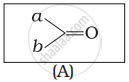
Which of the following is the correct representation for intermediate of nucleophilic addition reaction to the given carbonyl compound (A):
(i) 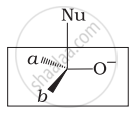
(ii) 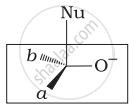
(iii) 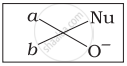
(iv) 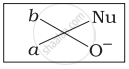
Advertisements
उत्तर
(i)
(ii)
Explanation:
The given compound is a planar molecule with sp2 hybridized carbon. Carbon atoms are attacked by nucleophiles. If the nucleophile approaches from the front, the (i) and (ii) molecules shift to the front and back positions, respectively and the carbon becomes tetrahedral. Another alternative is that (i) and (ii) molecules will be located above and below the plane, respectively. As a result, the choices (iii) and (iv) aren't represented as planar molecules.
APPEARS IN
संबंधित प्रश्न
Write the products formed when CH3CHO reacts with the following reagents : H2N – OH
What is meant by the following term? Give an example of the reaction in the following case.
Semicarbazone
What is meant by the following term? Give an example of the reaction in the following case.
Oxime
Predict the products formed when cyclohexanecarbaldehyde reacts with the following reagents.
PhMgBr and then H3O+
Give plausible explanation for the following:
Cyclohexanone forms cyanohydrin in good yield but 2, 2, 6 trimethylcyclohexanone does not.
How are the following compounds prepared?
benzaldehyde from benzoyl chloride
Write balanced chemical equations for action of ammonia on - acetone
What are amines?
Write the main product formed when propanal reacts with the following reagents:
H2N- NH2 followed by heating with KOH in ethylene glycol.
Alkenes  and carbonyl compounds
  , both contain a π bond but alkenes show electrophilic addition reactions whereas carbonyl compounds show nucleophilic addition reactions. Explain.
Identify the compounds A, B and C in the following reaction.
\[\ce{CH3 - Br ->[Mg/ether] (A) ->[(i) CO][(ii) Water] (B) ->[CH3OH/H+][Δ] (C)}\]
Paraldehyde is formed as a result of polymerisation:-
The most stable reagent for the conversion of R – CH2OH → RCHO is
Write the name of product formed, when acetone is treated with 2, 4-dinitrophenyl hydrazine.
What happens when ethanal is treated with excess ethanol and acid?
Draw structures of the given derivatives.
The ethylene ketal of hexan-3-one
Draw the structure of the following derivative.
The ethylene ketal of hexane-3-one
The product of the following reaction is
\[\begin{array}{cc}
\ce{O}\phantom{.........}\\
||\phantom{.........}\\
\ce{C2H5 - C - CH3 ->[H2/Ni][\Delta] \phantom{..}?}\end{array}\]
Draw structure of the following derivative:
Acetaldehydedimethylacetal
