Advertisements
Advertisements
प्रश्न
How are the following compounds prepared?
benzaldehyde from benzoyl chloride
Advertisements
उत्तर
Benzaldehyde from benzoyl chloride

Rosenmund Reduction
APPEARS IN
संबंधित प्रश्न
Acetaldehyde, when treated with which among the following reagents does NOT undergo addition reaction?
(A) Ammonia
(B) Hydroxylamine
(C) Ammoniacal silver nitrate
(D) Semicarbazide
Predict the product of the following reaction:
\[\begin{array}{cc}
\phantom{..............}\ce{O}\\
\phantom{..............}||\\
\ce{R - CH = CH - CHO + NH2 - C - NH - NH2 ->[H+]}\end{array}\]
What is meant by the following term? Give an example of the reaction in the following case.
Cyanohydrin
Acetaldehyde, Acetone, Di-tert-butyl ketone, Methyl tert-butyl ketone (reactivity towards HCN)
How will you bring about the following conversion in not more than two steps?
Bromobenzene to 1-Phenylethanol
How are the following compounds prepared?
acetophenone from benzene
Write balanced chemical equations for action of ammonia on - acetaldehyde
What is the action of the following reagents on ethanoic acid?
1) `LiAlH_4"/"H_3O^+`
2) `PCl_3 , "heat"`
3) `P_2O_5, "heat"`
What are amines?
Acetone, Acetaldehyde, Benzaldehyde, Acetophenone – reactivity towards addition of HCN.
Benzaldehyde can be obtained from benzal chloride. Write reactions for obtaining benzalchloride and then benzaldehyde from it.
Alkenes  and carbonyl compounds
  , both contain a π bond but alkenes show electrophilic addition reactions whereas carbonyl compounds show nucleophilic addition reactions. Explain.
Identify the compounds A, B and C in the following reaction.
\[\ce{CH3 - Br ->[Mg/ether] (A) ->[(i) CO][(ii) Water] (B) ->[CH3OH/H+][Δ] (C)}\]
Reaction of aqueous sodium hydroxide on chlorobenzene gives which of the following products?
Grignard reagent on reaction with acetone forms.
A Idol condensation will not be observed in
Paraldehyde is formed as a result of polymerisation:-
Which will undergo faster nucleophilic addition reaction?
Acetaldehyde or Propanone
The increasing order of the following compounds towards HCN addition is:
| (i) |  |
| (ii) |  |
| (iii) |  |
| (iv) |  |
Out of p-tolualdehyde and p-nitrobenzaldehyde, which one is more reactive towards nucleophilic addition reactions, why?
Write the structure of the product formed when acetone reacts with 2, 4 DNP reagent.
Draw structure of the following derivative:
Acetaldehydedimethylacetal
Draw structure of the following derivative.
The ethylene ketal of hexan-3-one
Draw structure of the following derivative.
The ethylene ketal of hexan-3-one
Draw structures of the given derivatives.
The ethylene ketal of hexan-3-one
Draw the structure of the given derivative.
The ethylene ketal of hexan-3-one
Complete the following reaction:
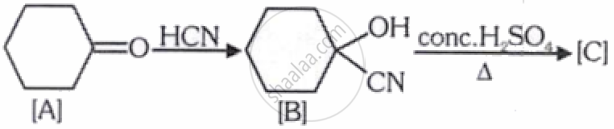
[C] is __________.
