Advertisements
Advertisements
प्रश्न
What happens when ethanal is treated with excess ethanol and acid?
Advertisements
उत्तर
When ethanal reacts with excess ethanol and acid gives acetal.
\[\begin{array}{cc}
\phantom{.......}\ce{CH3}\phantom{.........................}\ce{CH3}\phantom{....}\ce{OC2H5}\\
\phantom{....}\backslash\phantom{..........................}\backslash\phantom{..}/\\
\ce{= O + \underset{(excess)}{C2H5OH} ->[H^⊕]}\\
\phantom{....}/\phantom{..........................}/\phantom{..}\backslash\\
\phantom{.........}\ce{H}\phantom{.........................}\ce{H}\phantom{.....}\ce{OC2H5}\\
\end{array}\]
APPEARS IN
संबंधित प्रश्न
Acetaldehyde, when treated with which among the following reagents does NOT undergo addition reaction?
(A) Ammonia
(B) Hydroxylamine
(C) Ammoniacal silver nitrate
(D) Semicarbazide
How are the following compounds prepared?
acetophenone from benzene
Write the main product formed when propanal reacts with the following reagents:
2 moles of 3 CH OH in presence of dry HCl
Paraldehyde is formed as a result of polymerisation:-
What happens when propanone is treated with CH3MgBr and then hydrolysed?
The increasing order of the following compounds towards HCN addition is:
| (i) |  |
| (ii) |  |
| (iii) |  |
| (iv) |  |
Out of p-tolualdehyde and p-nitrobenzaldehyde, which one is more reactive towards nucleophilic addition reactions, why?
Draw the structure of the following derivative.
The ethylene ketal of hexan-3-one
Draw structures of the following derivatives.
Acetaldehydedimethylacetal
Complete the following reaction:
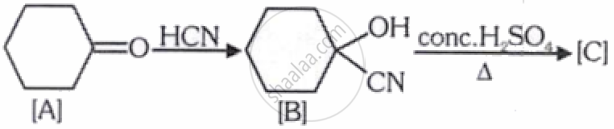
[C] is __________.
